Why U.S. Companies Are Rethinking Their Workforce Models in 2026
Introduction: A Structural Shift Beyond Cyclical Cost‑Cutting
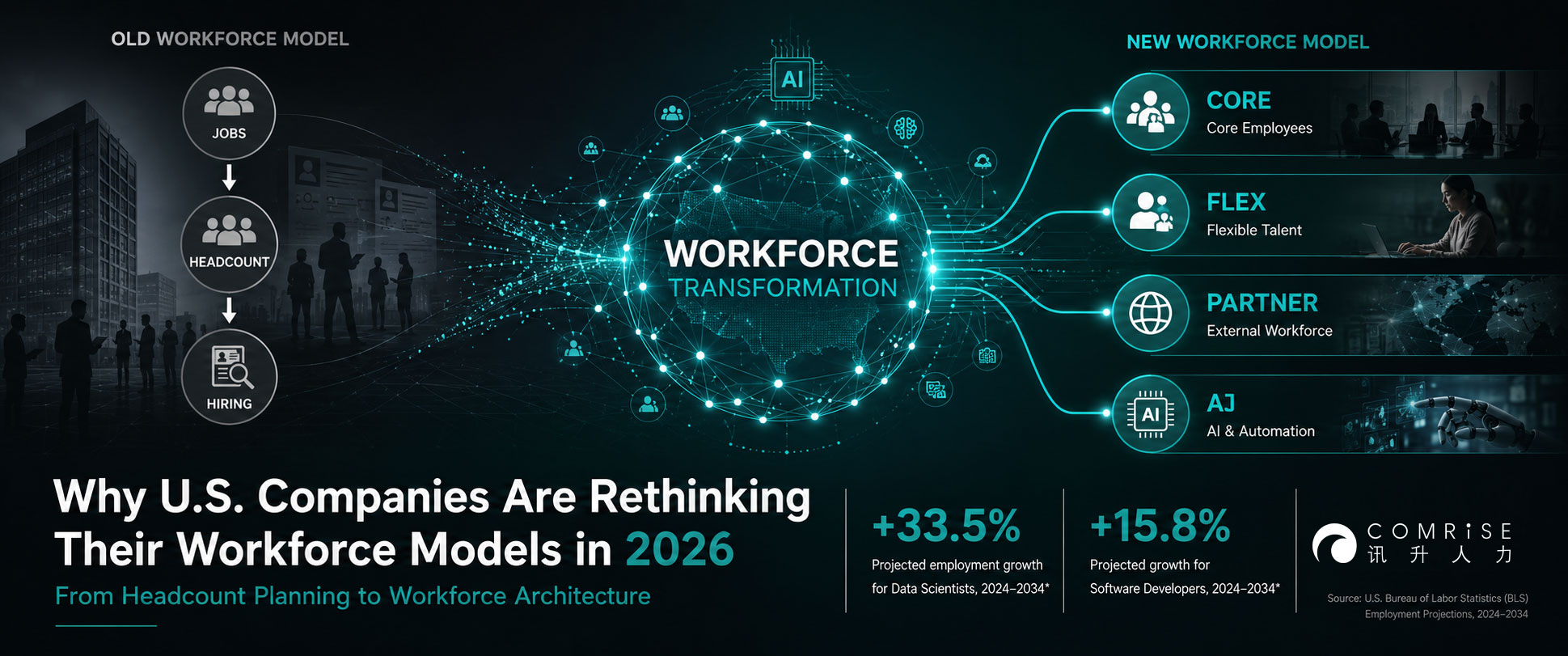
U.S. corporations are no longer adjusting headcount for short‑term economic cycles. Across technology, financial services, manufacturing and professional services, leadership teams are fundamentally re‑evaluating how work gets done, who performs it, and how talent capacity is built and scaled in 2026.
Research from Goldman Sachs estimates that AI is reshaping roughly 25% of working hours across U.S. industries, driving task displacement while creating demand for new human capabilitiesGoldman Sa…. Korn Ferry industry analysis adds that nearly half of large U.S. organizations are revising their workforce architecture rather than merely executing layoffs or hiring freezes. What many observers label cost‑cutting is, in reality, a strategic reset of workforce models.
For talent and business leaders, the central question is no longer “how many employees do we need?” but “what mix of talent structures enables sustainable growth amid technological and market uncertainty.”
Four Core Forces Reshaping U.S. Workforce Design in 2026
1. AI‑led Task Redefinition: From Headcount to Task‑Based Capacity
Generative AI has moved from experimental tool to day‑to‑day operational infrastructure. Routine administrative, analytical and coding tasks previously performed by full‑time staff can now be automated or augmented by AI systems. As Goldman Sachs research highlights, AI creates net friction in the U.S. labor market: certain roles shrink, while demand rises for skills centred on AI oversight, critical thinking and stakeholder collaboration.
This reality forces enterprises to decouple “tasks” from “permanent job roles”. Many legacy full‑time positions built around repeatable workflows are being dismantled. Companies are shifting toward capacity planning: identifying which work must stay in‑house with core employees, and which tasks can be delivered via AI tools, contractors or specialized project‑based talent.
2. Persistent Cost‑Efficiency Pressure from Capital Markets
Public‑market investors have updated valuation benchmarks for U.S. enterprises. Beyond top‑line revenue growth, boards are increasingly scrutinizing labour expenditure, productivity ratios and return‑on‑talent investment.
S&P 500 firms face consistent pressure to improve operating margins without sacrificing innovation capacity. Broad permanent hiring sprees are viewed as rigid liabilities in volatile conditions. Rather than expanding fixed payroll, leadership teams prefer variable talent costs that scale up and down aligned with business cycles and project pipelines.
3. Evolving Talent Expectations for Flexibility and Skill Mobility
Talent preferences continue to reshape hiring feasibility. Korn Ferry 2026 talent acquisition research notes that rigid full‑time on‑site requirements create tangible recruiting friction for high‑demand skilled talent, especially within tech and engineering pools.
Top performers prioritize autonomy, project diversity and continuous skill growth over long‑term tenured roles alone. Many skilled professionals actively seek contingent, contract or project‑based engagements. This shift gives U.S. companies access to specialized talent pools that would not accept traditional permanent employment offers.
4. Risk Mitigation: Building Resilience Against Market Volatility
After repeated cycles of boom‑and‑bust labour markets, corporate leadership prioritizes organizational resilience. Fixed full‑time‑heavy workforce structures create downside risk during demand contraction. Meanwhile, purely contractor‑heavy models bring risks of institutional knowledge loss, compliance exposure and inconsistent delivery quality.
Forward‑thinking U.S. firms design workforce models to balance scalability and stability, preparing for inflation swings, sector‑specific downturns and fast‑moving competitive threats.
Dominant Workforce Models Gaining Traction Among U.S. Enterprises
Hybrid Talent Ecosystem: Blending Full‑Time Core and Contingent Talent
The most widely adopted framework is a two‑tier workforce: a small, high‑impact core of permanent full‑time employees responsible for strategy, institutional knowledge and stakeholder relationships; supplemented by flexible contingent talent including contractors, statement‑of‑work specialists and project teams for variable‑volume work.
This model decouples fixed payroll from business fluctuations. It allows companies to ramp up for product launches and scale back without broad permanent headcount adjustments.
Skill‑Based Organization Over Traditional Job‑Centric Structures
Instead of organizing around static job descriptions, more U.S. enterprises map work to required skills. Roles are rewritten: repetitive tasks shift to automation, while human talent focuses on judgment‑heavy, high‑value activities.
Under this model, hiring, performance evaluation and internal mobility revolve around skill sets rather than formal job titles, matching talent capacity dynamically to business priorities.
Global Distributed Talent to Offset Domestic Talent Shortages
Domestic skill gaps persist across engineering, advanced manufacturing and specialized technical functions. Increasingly, U.S. businesses look beyond North‑America‑only hiring. By leveraging compliant global talent deployment, firms access hard‑to‑find expertise while optimizing total talent cost, rather than competing for overpriced local talent pools. This global workforce approach requires robust governance, compliance and talent operations capabilities.
Hidden Trade‑Offs: Risks Companies Face While Reshaping Workforce
Restructuring workforce models delivers compelling benefits, yet it carries under‑recognized risks, as highlighted in Korn Ferry and Goldman‑led industry analysis:
- Erosion of institutional knowledge: Over‑reliance on short‑term contract talent risks losing internal context, culture memory and long‑term capability building.
- Compliance exposure: Expanded contingent and global workforce increases regulatory risk around worker classification, local labour laws and cross‑border employment rules.
- Fragmented employee experience: Mismanaged hybrid talent ecosystems can create two‑tier culture between permanent and contract staff, hurting collaboration and output quality.
- Over‑optimism on AI substitution: Many firms overestimate AI’s near‑term ability to replace complex judgment‑based work, creating execution gaps after headcount reductions.
Successful re‑design is not simply reducing full‑time staff; it is intentional architecture balancing core human capital, flexible talent and technology.
Actionable Checklist for C‑Suite and Talent Leaders
Drawing on real‑world U.S. enterprise transformations, leadership teams can use these practical steps:
- Map your work portfolio: Separate high‑judgment core work from repeatable, project‑based or automatable tasks.
- Define clear boundaries between permanent core roles, contingent talent and AI‑delivered output.
- Audit compliance frameworks before scaling contingent or globally‑distributed workforce models.
- Retain investment in upskilling for core full‑time teams to work alongside AI systems.
- Establish consistent performance metrics across all talent segments, not only permanent employees.
- Partner with specialized talent solutions providers to de‑risk global and contingent workforce execution.
Conclusion: Workforce Model as a Strategic Competitive Lever
2026 marks an inflection point for U.S. human capital strategy. Workforce‑model redesign is no longer an HR‑only initiative; it sits at the intersection of finance, technology and corporate strategy.
Companies that treat workforce architecture as a static legacy structure risk higher costs, talent gaps and slower adaptation to AI‑driven market change. Those that build balanced, resilient talent ecosystems combining core full‑time teams, flexible contingent capacity and global talent access will gain durable competitive advantage.
Comrise partners with U.S. and multinational enterprises to design and execute agile workforce strategies — from RPO and contingent workforce management to compliant global talent deployment, helping clients navigate this new era of workforce transformation.