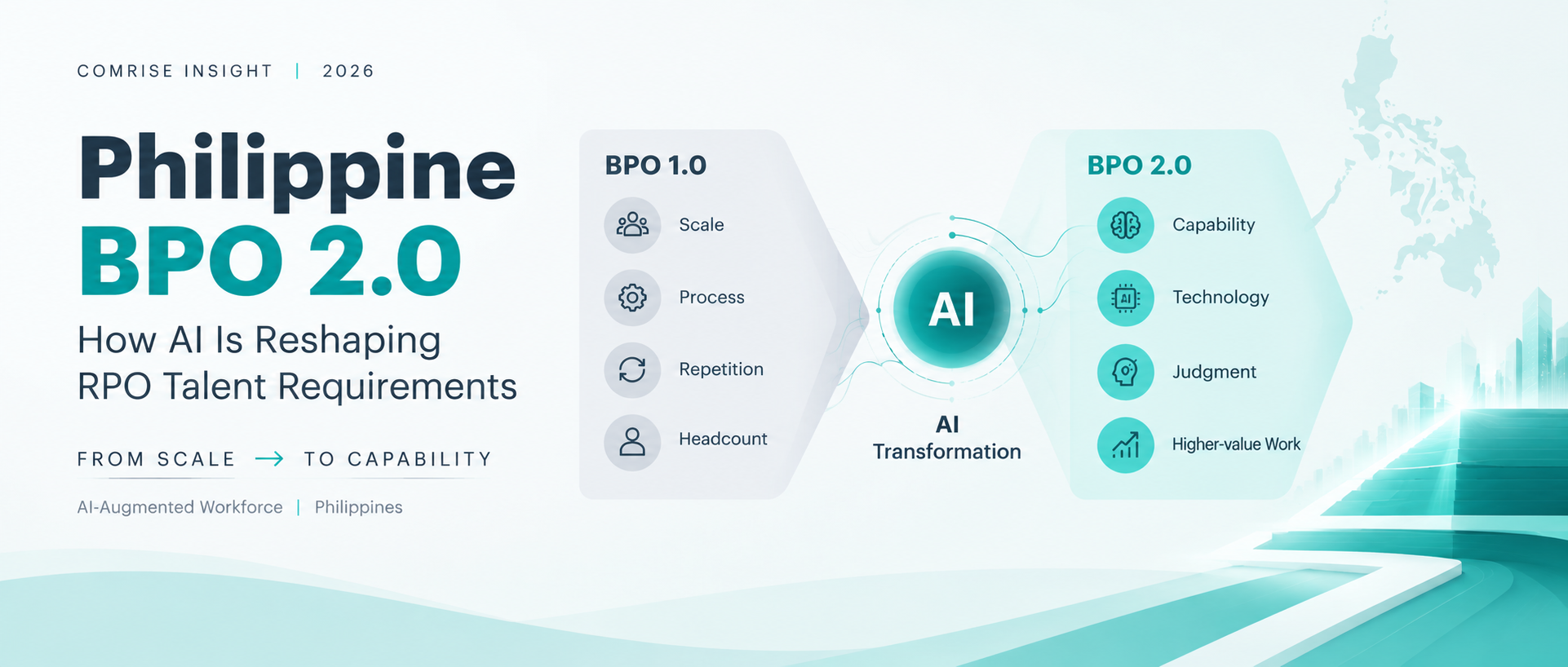
Philippine BPO 2.0: How AI Is Reshaping RPO Talent Requirements in 2026
The Philippines has built its global BPO leadership on scale, service quality, and a highly capable English-speaking workforce. But as AI changes how business processes are delivered, the next competitive advantage will depend less on headcount and more on workforce capability.
For more than two decades, the Philippines has been one of the world’s leading destinations for business process outsourcing. Its combination of a large talent pool, English proficiency, cultural affinity with global markets, and established delivery infrastructure has supported the rapid expansion of the IT-BPM industry.
The sector closed 2025 at approximately US$40 billion in revenue and 1.9 million jobs, with further growth expected in 2026.
But the industry’s growth model is changing.
Artificial intelligence is increasingly automating repetitive tasks while creating opportunities for more complex, specialized, and technology-enabled services. The question for employers is therefore no longer simply how many people they can hire, but what capabilities those people can bring to an AI-enabled operating model.
For RPO providers, this shift has major implications.
The future of Philippine BPO hiring will not be defined by hiring more people faster. It will be defined by identifying, assessing, and building the right capabilities for a workforce where humans and AI work together.
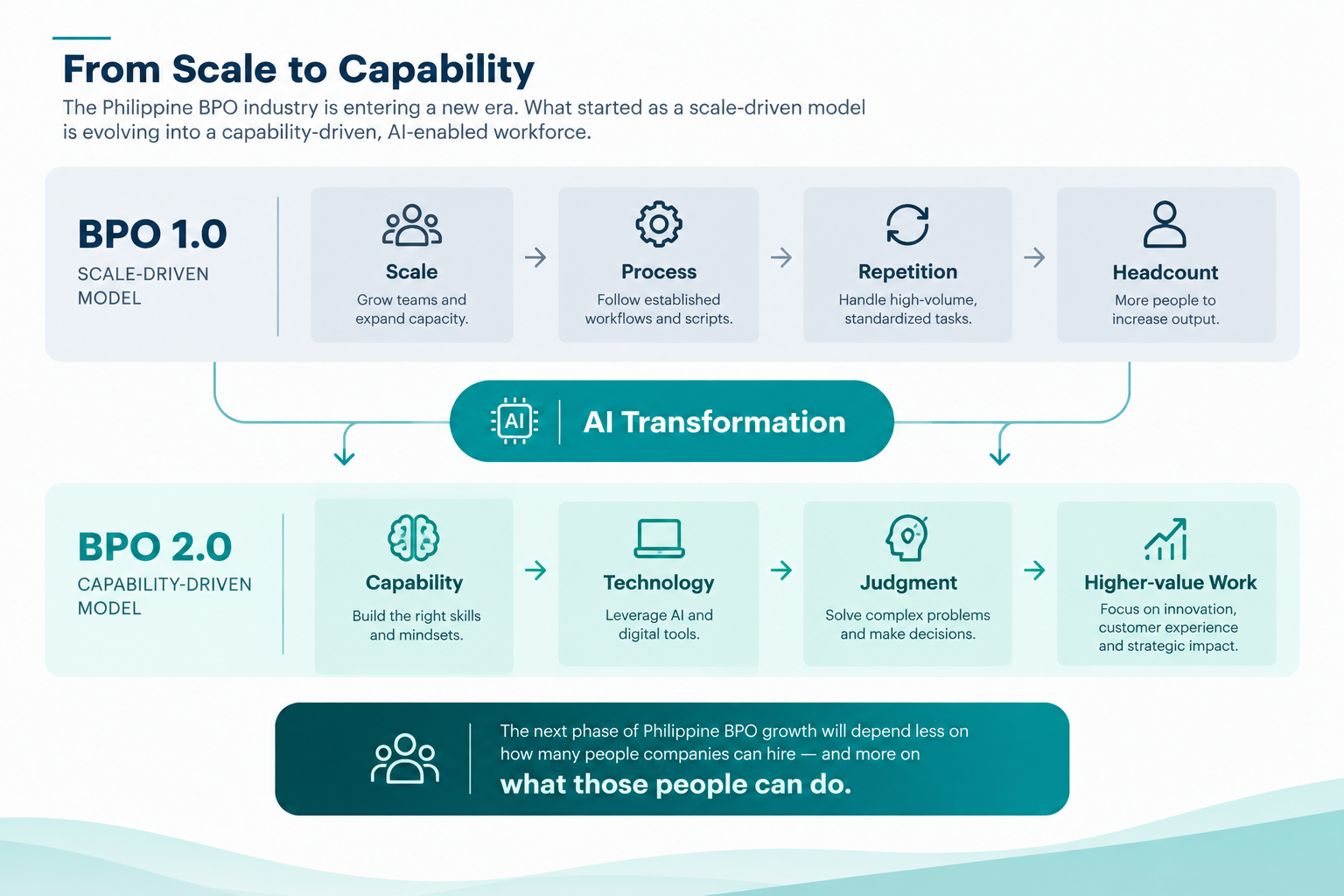
1. How Philippine BPO Hiring Is Moving from Scale to Capability
The traditional Philippine BPO model was largely built around scale.
Companies could achieve cost efficiency and service quality by establishing large teams to handle standardized, repeatable processes such as customer service, transaction processing, technical support, and back-office operations.
This model remains important. However, its economics are changing.
The OECD notes that BPO still represents the majority of Philippine IT-BPM employment, while global capability centers, healthcare information management, and IT/software services are becoming increasingly important components of the ecosystem. At the same time, AI presents a significant structural challenge to routine and clerical work.
Industry leaders are responding by moving toward higher-value services.
In 2026, IBPAP and industry partners have increasingly emphasized workforce upskilling, AI readiness, and the transition from basic support work toward more complex services.
2. How AI Is Changing Philippine BPO Hiring
Much of the discussion around AI and BPO focuses on job displacement.
There is a real risk. Routine, predictable, high-volume tasks are among the areas most exposed to automation, and the OECD identifies BPO workers as particularly exposed to generative AI.
But focusing only on job elimination misses the larger transformation.
AI is changing the composition of work.
Consider the difference between a traditional BPO environment and an AI-augmented operation:
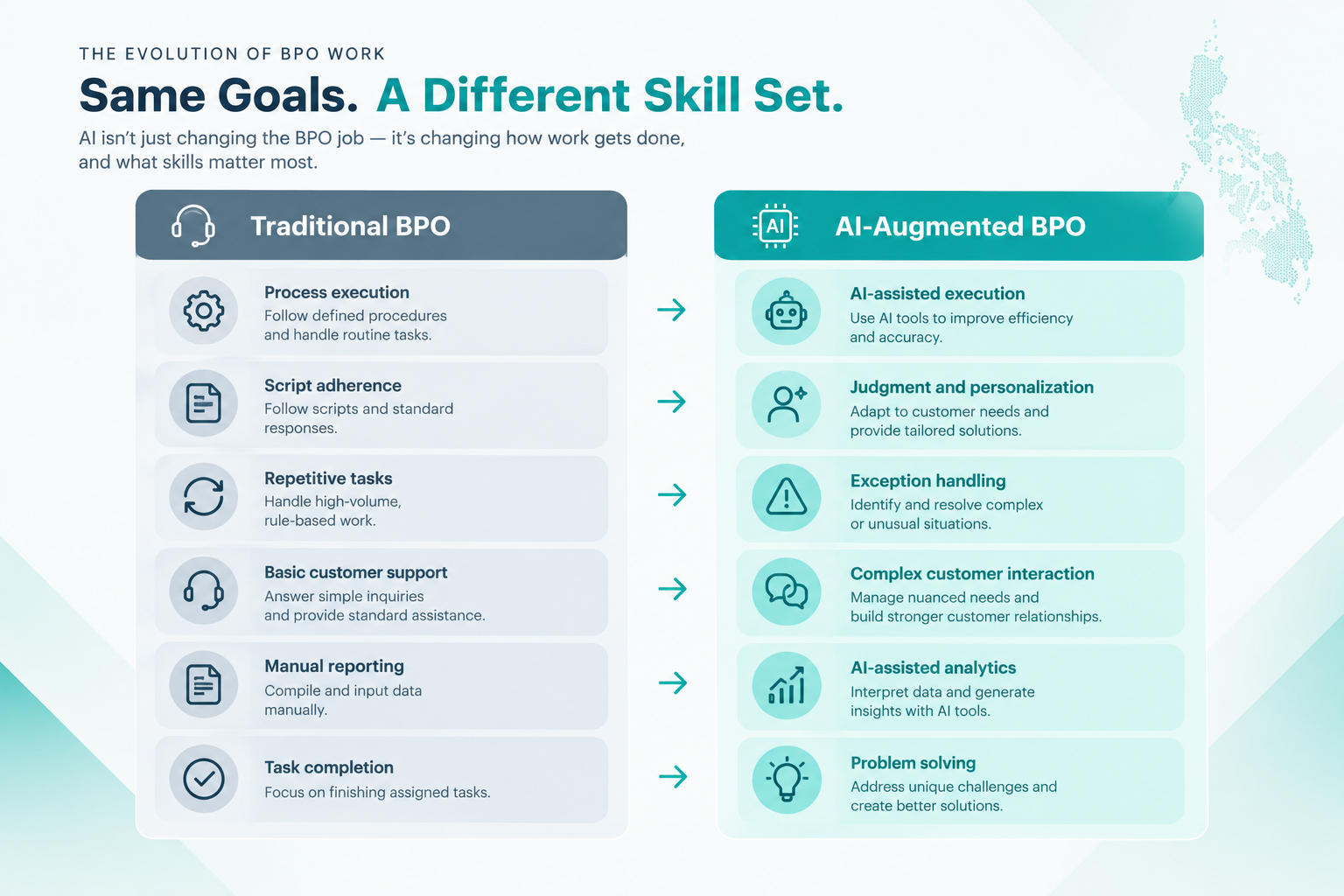
Employees are expected not only to execute a process, but to understand the process, identify exceptions, interpret information, work with AI tools, and make decisions when automated systems cannot provide an appropriate answer.
Recent industry initiatives in the Philippines reflect this direction. Converge and IBPAP, for example, have emphasized upskilling workers for more complex work as AI takes over more routine activities.
The result is not simply fewer jobs.
It is different jobs requiring different capabilities.
3. What AI-Augmented BPO Means for Philippine BPO Hiring and RPO
This is where the transformation becomes particularly important for recruitment.
Traditional RPO models often optimize for:
- Hiring volume
- Time-to-fill
- Cost-per-hire
- Candidate availability
- Process efficiency
These metrics remain important.
But they are no longer enough when clients are building AI-enabled operations.
RPO must increasingly answer a different question:
Can we identify people who can succeed in a workforce model that is continuously changing?
Five capabilities are becoming increasingly important.
a. AI Literacy
Not every BPO employee needs to become an AI specialist.
But candidates increasingly need to understand how to work effectively with AI-enabled tools and workflows.
Relevant capabilities can include:
- AI tool familiarity
- Digital workflow skills
- Basic prompt literacy
- Data interpretation
- AI-assisted productivity
- Understanding of automation workflows
The objective is not to hire an “AI expert” for every role.
It is to build a workforce that is AI-ready.
b. Human Judgment
As AI becomes better at handling standardized tasks, human judgment becomes more valuable.
Candidates need to demonstrate:
- Critical thinking
- Decision-making
- Escalation management
- Risk awareness
- Complex problem solving
- Situational judgment
The future BPO employee may spend less time following a script and more time deciding what to do when the script no longer applies.
c. Communication and Empathy
Communication remains one of the Philippines’ most important workforce advantages.
But the definition of communication is changing.
For higher-value BPO services, employers increasingly need more than English proficiency.
They need:
Communication + empathy + judgment
This is particularly important in customer experience, healthcare information management, financial services, technical support, and other complex service environments.
Human interaction remains valuable precisely where context, trust, emotional intelligence, and judgment matter.
d. Adaptability
One of the biggest changes in recruitment is the shift from hiring for a fixed process to hiring for continuous change.
The traditional question was:
Can this candidate follow the process?
The new question is:
Can this candidate learn when the process changes?
AI-enabled organizations will continuously introduce new tools, workflows, automation systems, and performance expectations.
Adaptability therefore becomes a workforce capability rather than simply a desirable soft skill.
e. Digital and Domain Skills
The most valuable candidates may increasingly combine three elements:
Domain expertise + digital capability + human skills
For example:
- Finance + AI tools
- Healthcare + data literacy
- Customer service + automation
- Sales + CRM analytics
- Technical support + AI-assisted troubleshooting
This creates a new talent profile: the digitally enabled domain professional.
4. RPO Must Evolve from Volume Hiring to Capability Hiring
If the workforce is changing, the recruitment model must change with it.
Traditional RPO can be represented as:
CV → Screen → Interview → Hire
But AI-augmented workforce planning requires a broader model:
Workforce Planning → Skills Mapping → AI-Enabled Assessment → Capability Hiring → Continuous Development
This changes the role of RPO.
RPO is no longer simply an outsourced recruitment engine.
It can become a workforce capability engine.
Instead of asking:
“How quickly can we fill 500 positions?”
the conversation increasingly becomes:
“What skills will this operation require over the next 12–24 months, and how do we build that talent pipeline?”
That distinction is critical for companies establishing or expanding operations in the Philippines.
5. The 2026 RPO Talent Assessment Framework for Philippine BPO Hiring
As job requirements evolve, traditional candidate screening also needs to evolve.
A practical 2026 framework should assess five dimensions:
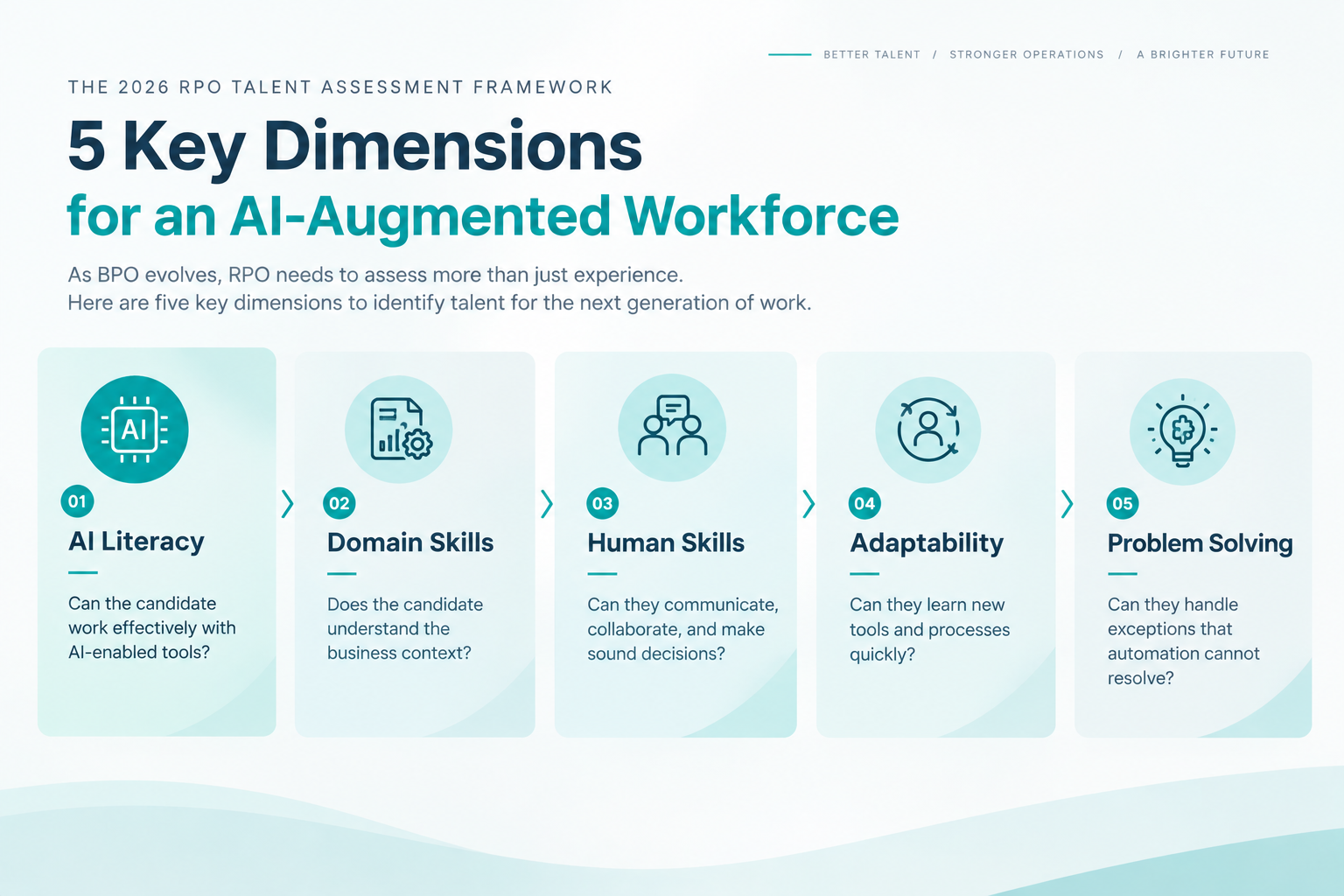
This framework changes the definition of a “qualified candidate.”
Previous experience remains relevant, but it is no longer the only indicator of future performance.
The more important question becomes:
Does this candidate have the capability to grow with the operating model?
This is especially important as employers move toward higher-complexity services.
6. What Employers Should Rethink in 2026
For companies building BPO, shared services, or technology-enabled operations in the Philippines, four changes should be considered.
a. Hire for AI readiness, not only AI expertise
AI skills should not be limited to technical roles.
Organizations should evaluate how effectively candidates can adopt AI-enabled tools within their specific workflows.
b. Assess transferable skills, not only previous BPO experience
A candidate from a traditional BPO role may have strong communication, problem-solving, and customer-management capabilities that can transfer into higher-value roles.
Recruitment should identify those underlying capabilities rather than relying only on job titles.
c. Build talent pipelines for higher-complexity roles
As routine work becomes increasingly automated, organizations need pipelines for roles requiring:
- Analytics
- Technology
- Specialized domain knowledge
- Quality and compliance
- Customer experience
- AI-enabled operations
d. Combine recruitment with upskilling
Recruitment and workforce development can no longer operate completely separately.
The Philippines is already expanding industry and government-led AI and digital upskilling initiatives, reflecting the growing importance of reskilling the existing workforce alongside developing new talent.
For employers, this means the best workforce strategy may combine:
Hire + Assess + Develop + Deploy
rather than simply Hire + Replace.
The Next Chapter of Philippine BPO
The Philippine BPO industry is entering a different phase.
AI will undoubtedly automate some tasks. But the more important transformation is the redesign of work itself.
The Philippines’ competitive advantage will increasingly depend on its ability to move talent from routine execution toward higher-value, AI-enabled work.
That means the winning workforce model will not be:
Humans versus AI
It will be:
Humans + AI + Better Workforce Design
For RPO, this creates a fundamental shift.
The goal is no longer simply to provide candidates at scale.
It is to help organizations identify the capabilities they need, access the right talent, assess candidates against future requirements, and build a workforce that can evolve alongside technology.
BPO 2.0 is not about having fewer people.
It is about building a workforce capable of creating more value.
For organizations expanding or transforming their Philippine operations, RPO is becoming more than a recruitment solution. It is becoming a workforce capability strategy.
Comrise helps organizations identify, attract, assess, and build talent for evolving BPO, shared services, and technology-enabled operations in the Philippines and across global markets.