Why Southeast Asia Is Becoming a Strategic Talent Hub
Southeast Asia is becoming a strategic talent hub for global companies.As companies rethink supply chains, expand advanced manufacturing, accelerate digital transformation, and diversify their international footprint, the region is becoming increasingly important for a different reason: talent.
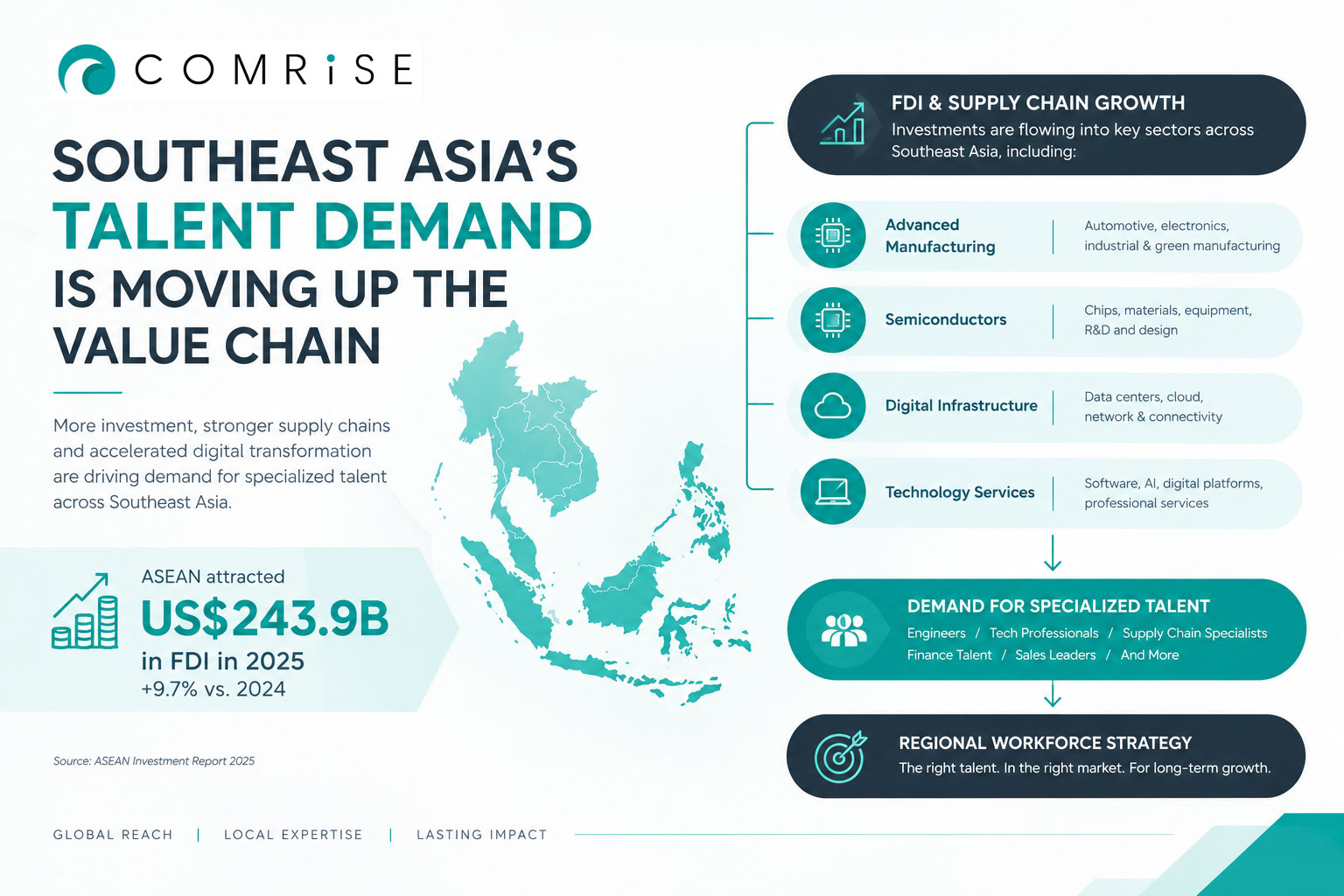
With more investment flowing into semiconductors, electronics, automotive, digital infrastructure, financial services, renewable energy, and advanced manufacturing, companies are building more sophisticated operations across Southeast Asia. This is creating demand for engineers, technology professionals, supply chain specialists, finance talent, sales leaders, and other skilled professionals.
In 2025, ASEAN attracted approximately US$243.9 billion in foreign direct investment, up 9.7% from 2024. Investment continued to target sectors including semiconductors, electronics, communications, renewable energy, and digital infrastructure.
The result is a shift in how companies should think about Southeast Asia.
The question is no longer simply where to locate operations. It is where to build the talent capabilities required to support long-term growth.
01 | From Cost Advantage to Strategic Talent Advantage
For many years, Southeast Asia was primarily viewed through the lens of labor cost.
That perspective is becoming increasingly incomplete.
The region now combines several advantages: a large and diverse workforce, growing pools of skilled professionals, expanding digital capabilities, established manufacturing ecosystems, and increasingly interconnected regional markets.
ASEAN itself highlights the diversity of its workforce, ranging from cost-competitive labor to highly skilled industry professionals and licensed specialists across sectors such as finance, technology, manufacturing, and renewable energy.
At the same time, investment is moving further up the value chain.
Manufacturing investment in Southeast Asia increased significantly in recent years, particularly in supply-chain-intensive sectors such as automotive, electronics, and semiconductors. Digital infrastructure, professional services, and technology-related activities are also attracting growing investment.
This changes the talent equation.
Companies entering the region increasingly need more than large numbers of employees. They need people who can manage complex operations, work with global teams, operate advanced technologies, and support increasingly sophisticated business models.
02 | Investment Is Creating New Talent Demand
The growth of Southeast Asia’s talent market is closely connected to the changing investment landscape.
The region attracted US$226 billion in FDI in 2024, representing around 15% of global FDI inflows. In 2025, that figure increased further to approximately US$243.9 billion.
But the more important question for employers is where that investment is going.
Across the region, companies are expanding in areas such as:
-
Semiconductors and electronics
-
Automotive and electric vehicles
-
Advanced manufacturing
-
Digital infrastructure and data centers
-
Technology and professional services
-
Renewable energy
-
Financial and business services
These industries require increasingly specialized talent.
For example, semiconductor expansion creates demand not only for engineers, but also for process engineering, equipment engineering, quality, supply chain, project management, technical sales, and operations leadership.
Similarly, digital infrastructure investment creates demand across cloud, cybersecurity, data, network engineering, project management, and technical operations.
As investment becomes more technology-intensive, talent availability becomes part of the location decision itself.
03 | Southeast Asia Is Not One Talent Market
One of the biggest mistakes companies make when expanding into Southeast Asia is treating the region as a single labor market.
ASEAN consists of diverse economies with different industrial strengths, talent pools, wage structures, languages, regulations, education systems, and workforce dynamics.
Singapore, for example, plays an important role as a regional headquarters, financial, technology, and innovation hub.
Malaysia has developed strong capabilities in electronics, semiconductors, shared services, and advanced manufacturing.
The Philippines has a large English-speaking workforce and a mature business process services ecosystem.
Vietnam has become increasingly important for manufacturing, electronics, technology, and supply-chain diversification.
Indonesia offers a large domestic market and growing opportunities across manufacturing, resources, digital services, and consumer sectors.
Thailand continues to develop strengths in automotive, electronics, manufacturing, and related services.
These markets are complementary rather than interchangeable.
ASEAN’s own investment framework emphasizes the advantages created by different levels of economic development and industry specialization across member states, allowing businesses to build regional value chains by combining different markets and capabilities.
For employers, this means that a regional workforce strategy should begin with a more specific question:
Which market has the right talent for each capability we need?
04 | The Rise of Regional Talent Networks
As companies expand across multiple Southeast Asian markets, their workforce models are also becoming more regional.
Instead of building every function independently in every country, companies are increasingly considering how different locations can play different roles within one regional operating model.
A company might establish regional leadership in Singapore, engineering and manufacturing capabilities in Malaysia or Vietnam, shared services in the Philippines, and market-facing or operational teams in Indonesia or Thailand.
This creates a regional talent network rather than a collection of disconnected country teams.
The development of ASEAN’s economic integration framework supports this direction. ASEAN’s long-term objective includes freer flows of goods, services, investment, capital, and skills across the region.
There are also mechanisms addressing the movement of people for business activities, including business visitors, intra-corporate transferees, and certain categories of service providers.
For global companies, this creates opportunities to think beyond traditional country-by-country hiring.
Talent can become part of a broader regional workforce strategy.
05 | The Talent Challenge Is Becoming More Complex
Growth in Southeast Asia does not mean that talent is automatically easy to find.
In fact, rapid investment can create the opposite problem.
When multiple companies enter the same market at the same time, competition for experienced professionals increases.
This is particularly relevant for specialized roles in engineering, technology, semiconductors, digital transformation, supply chain, and senior management.
ASEAN’s Digital Master Plan 2030 also identifies the growing digital talent gap as an important regional challenge, particularly in areas such as AI, cybersecurity, cloud engineering, and data science. It highlights the need for investment in digital education, lifelong learning, reskilling, and regional talent collaboration.
For employers, the implication is straightforward:
A location strategy without a talent strategy can create execution risk.
A company may identify the right market, secure facilities, establish operations, and obtain investment approvals—but still struggle to scale if the required talent cannot be built quickly enough.
06 | What Companies Need to Rethink When Building Teams in Southeast Asia
As Southeast Asia becomes a more strategic talent hub, companies may need to move away from a purely country-based hiring approach.
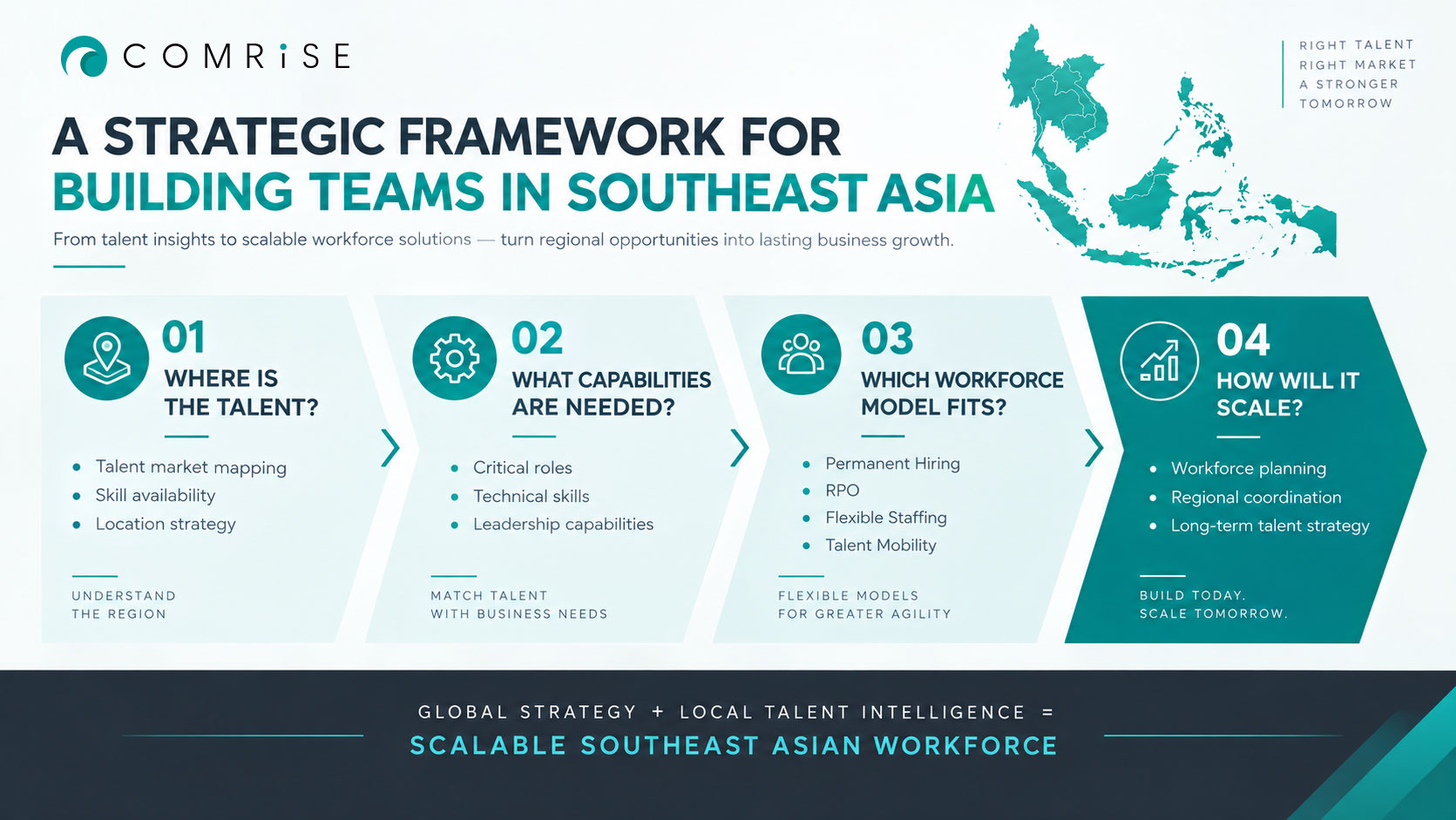
A more effective workforce strategy can consider four questions.
a. Where is the talent?
Map the availability of critical skills by country, city, and industry cluster.
The relevant question is not simply whether a country has enough workers, but whether it has the specific capabilities required by the business.
b. What capabilities are needed?
Separate critical roles from scalable roles.
Engineering, technology, leadership, sales, operations, and support functions may require different sourcing strategies and different locations.
c. Which workforce model fits?
Permanent hiring is not always the only option.
Depending on the stage of expansion, companies may combine:
Permanent hiring | RPO | Flexible staffing | Talent mobility | Regional delivery models
This allows organizations to build capabilities while managing speed, flexibility, and workforce costs.
d. How will the workforce scale?
The initial hiring plan should not be separated from the long-term workforce strategy.
Companies should consider how talent acquisition, onboarding, workforce mobility, leadership development, and regional coordination will evolve as operations grow.
07 | From Regional Expansion to Regional Workforce Strategy
Southeast Asia’s transformation is creating a different type of opportunity for global employers.
The region is becoming not only a destination for operations, but a network of complementary talent markets supporting increasingly sophisticated global businesses.
The combination of investment, supply-chain diversification, advanced manufacturing, digital transformation, and regional integration is creating sustained demand for specialized talent.
For companies expanding into Southeast Asia, the competitive question is therefore shifting:
Not simply “Where should we hire?”
But:
“How should we build the workforce capabilities that allow our Southeast Asian operations to scale?”
That requires local market intelligence, regional workforce planning, access to specialized talent, and the flexibility to combine different hiring and workforce models.
Building a Scalable Southeast Asian Workforce
At Comrise, we help global companies navigate the talent challenges that come with international expansion.
Our capabilities across Recruitment Process Outsourcing (RPO), permanent recruitment, flexible staffing, cross-border talent solutions, and Talent Mobility enable companies to connect workforce strategy with local talent markets.
With teams and delivery capabilities across Southeast Asia and other major global markets, è®¯å‡ supports organizations in identifying talent, building teams, and scaling their international workforce.
Global strategy needs local talent intelligence.
And in Southeast Asia, that connection is becoming increasingly strategic.