The race between China and the U.S. in AI has captured global attention. From ChatGPT to DeepSeek, AI is no longer just a buzzword. It has become the real battlefield of the future. The White House recently released its latest AI Talent Report. It reveals a critical shortage of AI professionals in the U.S.—exceeding 4 million.
The Council of Economic Advisers (CEA) published this detailed AI talent report. It provides a comprehensive overview of the current AI workforce landscape in the United States.

The CEA advises the White House on economic policy. It offers analysis and recommendations to the President. Its research influences both short-term decisions and long-term strategies. These include technology, employment, and industrial development.
The AI Talent Shortage in the U.S.
Rapid AI development continues to drive demand for high-end talent. Both the software and hardware sectors face significant shortages. This is especially true in R&D and core infrastructure.
The White House report openly warns about the talent gap. It has reached a “red alert” level. Currently, 36% of AI-related jobs in the U.S. remain unfilled. Some fields struggle to find qualified experts.
AI labs have a strong and growing need for top software talent.
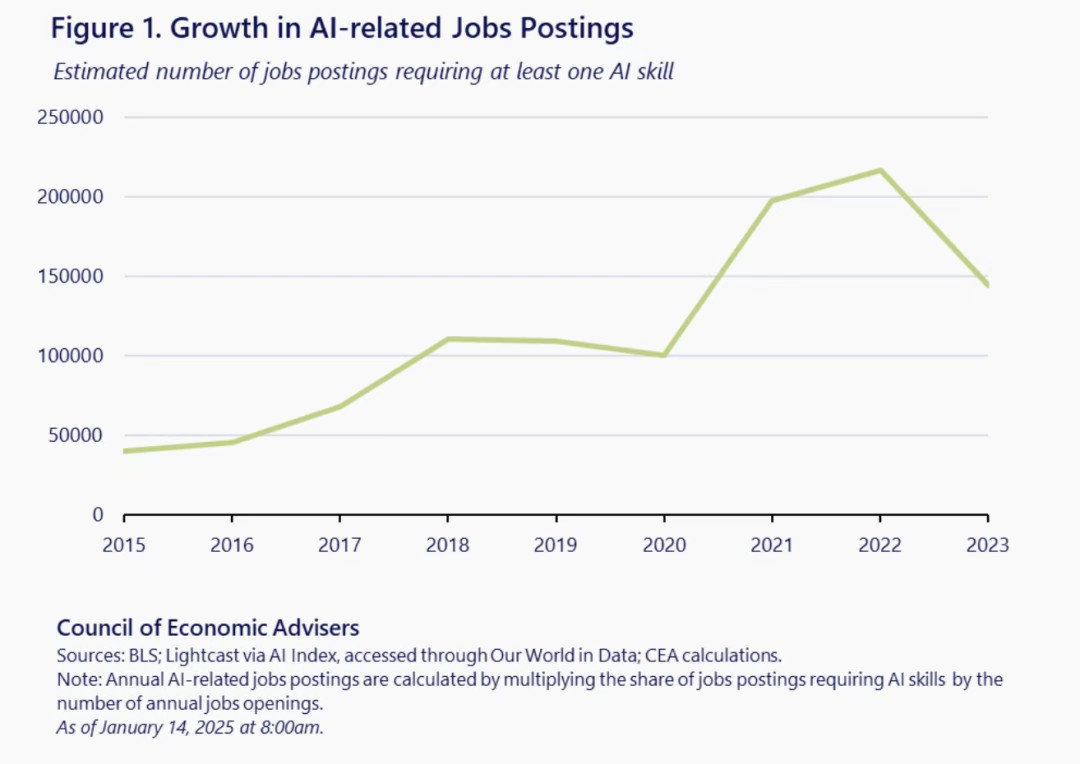
From 2015 to 2023, job postings requiring AI skills grew by 257%. This far exceeds the overall job growth rate of 52% during the same period. Demand for AI talent is expanding rapidly. But supply can’t keep up.
Leading AI research organizations like OpenAI and Google DeepMind are always hiring. They need machine learning engineers, software engineers, and research scientists. Training a single AI model can cost over $100 million. To attract the best talent, top AI labs spend 29% to 49% of their budget on labor.
The hardware sector also needs more AI professionals. This is especially true in data centers and semiconductor supply chains.
Back in 2021, U.S. data center investments reached $48 billion. But talent is scarce. Annual talent demand in this field is growing by 3%. Cloud computing is a major driver.
Most data center jobs require advanced degrees. But the education system isn’t producing enough graduates. The supply can’t match industry growth.
The semiconductor supply chain also relies on highly educated workers. Design, manufacturing, packaging, and testing all need experts. Over 50% of workers need at least a bachelor’s or graduate degree. There is a global shortage of chip engineers. This limits production capacity and slows AI development.
Where U.S. AI Talent Comes From
The U.S. relies on three main strategies to boost AI talent supply:
First, increase the number of AI graduates from U.S. universities. Support policies include expanding AI program enrollment, investing in teaching resources, and promoting AI career information. This helps raise university enrollment and graduation rates.
Second, attract international AI talent and reduce outflow. This involves lowering immigration barriers and reforming visa policies. Examples include improving the H-1B visa and green card systems.
Third, encourage professionals from other industries to enter AI. More funding for AI research and better policies can attract more talent.
The report focuses mainly on the first strategy—university-trained AI talent.
The CEA designed a degree-based classification system for AI talent. It recognizes that AI skills come from many fields—not just “AI” majors. Out of 2,320 academic fields in the NCES IPEDS database, the CEA classified 154 as AI-related.
International Students Fuel U.S. AI Talent
Over the past decade, U.S. universities have awarded more AI-related degrees. Bachelor’s degrees more than doubled. Computer and information sciences made up 42% of this growth. Master’s degrees increased by 71%. Doctorates grew by 48%. But it’s still not enough.
One key finding: international students are the backbone of U.S. AI talent. They account for over 58% of graduate students in core fields like computer science and data science.
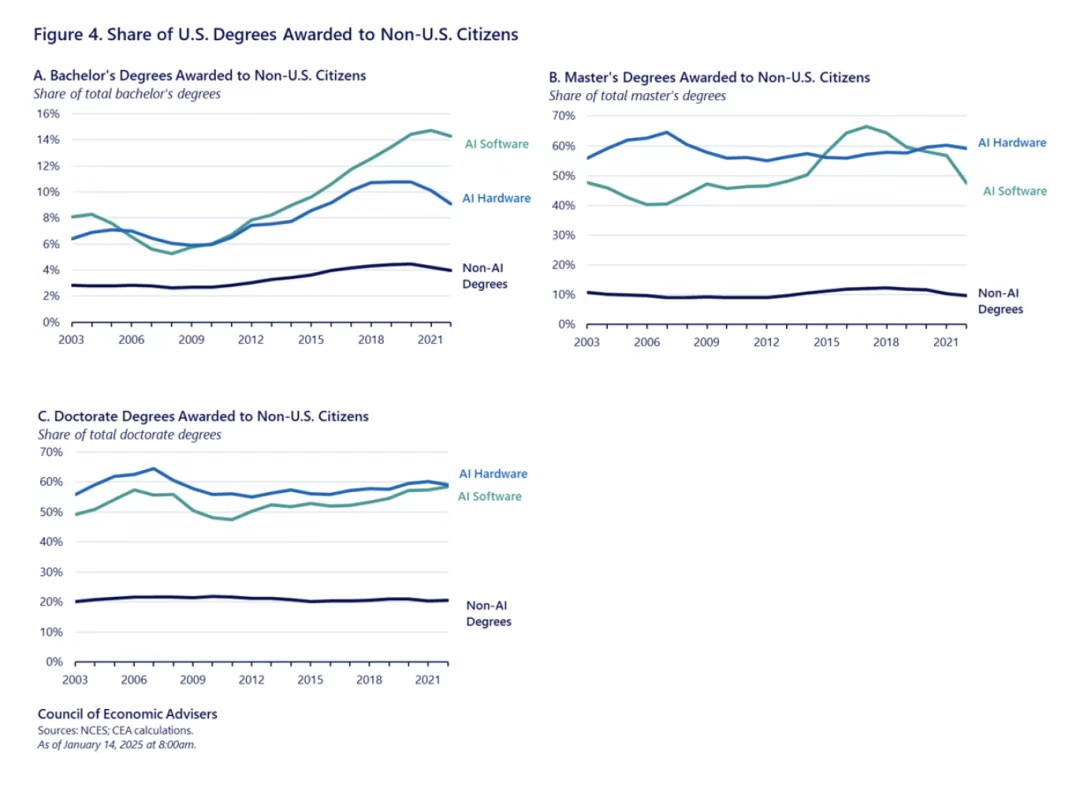
The report shows that non-U.S. citizens make up a large share of high-degree AI talent. They represent 40–60% of master’s graduates.
Among Ph.D. graduates, the share of non-U.S. citizens has exceeded 50% since 2003. It reached 59% in 2022. In other fields, international students usually make up around 20% of Ph.D. graduates.
The U.S. heavily depends on international talent in AI. Chinese students excel in computer science, electrical engineering, and mathematics. They compete for scholarships and research opportunities. And they build strong technical resumes.
讯å‡
At Comrise, we offer tailored solutions for the full-time, part-time, direct-hire, contract, and permanent talent that your business needs. For 40 years, we have delighted our clients and candidates by focusing on customer satisfaction, innovation, and flexible workforce solutions!
If you’re looking for new job opportunities click here, or if you’re looking for a reliable partner to help you secure top-notch candidates for hard-to-fill roles, click here. For more information, feel free to contact us, click here.