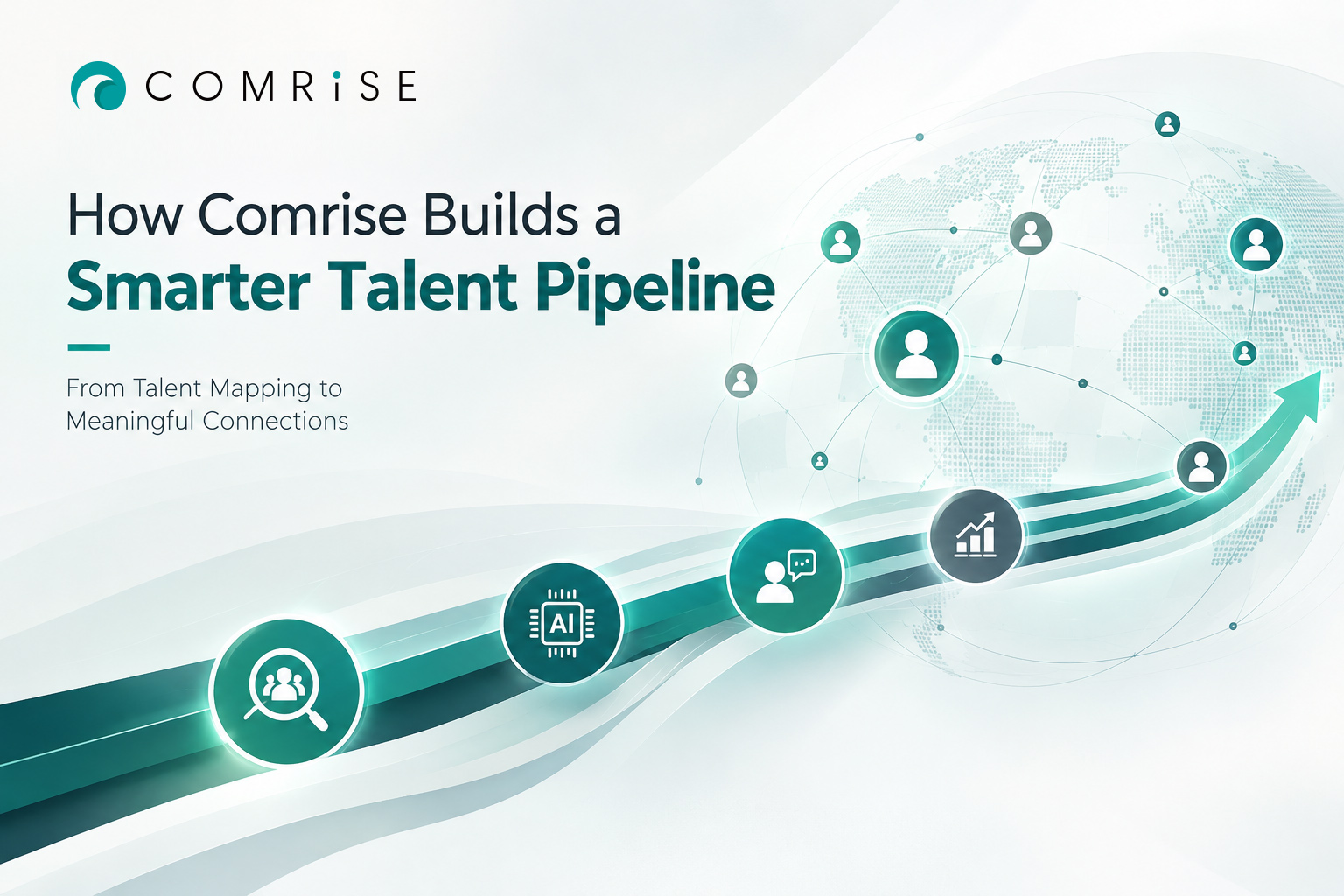
How Comrise Builds a Smarter Talent Pipeline
From Talent Mapping to Meaningful Connections: A More Proactive Approach to Recruitment
Introduction: Better Hiring Starts Before a Position Opens
Building a smarter talent pipeline helps organizations move beyond reactive hiring and identify the right talent before critical positions become urgent. By combining talent mapping, AI-assisted recruitment, and meaningful candidate engagement, businesses can strengthen their recruitment strategies and prepare for evolving workforce needs.
Yet the most effective hiring strategies begin much earlier.
Organizations need more than a database of resumes or a list of potential candidates. They need a structured approach to understanding talent markets, identifying relevant professionals, building relationships, and maintaining access to the skills their businesses will need.
This is where a smarter talent pipeline makes a difference.
At Comrise, we believe effective recruitment combines talent intelligence, technology-enabled workflows, and professional recruitment expertise. By connecting market research with targeted sourcing and candidate engagement, businesses can move beyond reactive hiring toward a more proactive and sustainable talent strategy.
1. Why a Smarter Talent Pipeline Matters
A job description defines what an organization needs today. Talent mapping helps uncover where the relevant capabilities exist and how to reach them.
Before launching a search, recruiters need to understand the broader talent landscape:
-
Target companies: Where are professionals with the relevant industry and functional experience working?
-
Skills and experience: Which capabilities distinguish strong candidates from those who simply match a job title?
-
Market availability: How accessible is the required talent, and what competition exists for those skills?
-
Location and mobility: Which markets offer potential talent pools, particularly for cross-border hiring?
-
Hiring expectations: What compensation, seniority, and role requirements are realistic in the target market?
This research provides a stronger foundation for recruitment decisions. It can also help hiring teams identify alternative talent pools, refine role requirements, and set more realistic expectations before a search begins.
For organizations hiring across multiple markets, local knowledge is especially important. Similar job titles can represent different responsibilities, skill requirements, and compensation expectations from one market to another.
A well-defined talent map helps turn these differences into actionable recruitment intelligence.
2. Talent Mapping: The Foundation of a Smarter Talent Pipeline
Technology is changing how recruiters search for and evaluate potential candidates. However, the value of AI is not simply its ability to process more resumes.
Its greater potential lies in helping recruiters identify relevant talent more efficiently.
When integrated into recruitment workflows, AI-assisted capabilities can support activities such as:
-
Job description analysis: Clarifying role requirements and identifying essential skills.
-
Resume parsing: Structuring candidate information for more consistent review.
-
Skills-based matching: Comparing candidate experience and capabilities with job requirements.
-
Talent search: Helping recruiters explore relevant profiles and potential adjacent talent pools.
-
Workflow coordination: Reducing repetitive administrative tasks throughout the recruitment process.
These capabilities can help recruitment teams spend less time on manual processing and more time evaluating candidate suitability, understanding career motivations, and building relationships.
The objective is not to replace professional judgment with automated rankings. It is to make the information available to recruiters more useful, so they can focus their attention where it matters most.
3. How AI Recruitment Improves Talent Pipeline Efficiency
A large talent database does not automatically create a strong talent pipeline.
The difference lies in how well candidate information is maintained, how meaningfully relationships are developed, and how effectively potential candidates are re-engaged when opportunities arise.
A more proactive approach involves several ongoing activities.
Identify and prioritize. Segment potential candidates according to relevant skills, experience, seniority, location, and likely role fit.
Build meaningful connections. Use personalized communication that reflects a candidate’s professional background and interests rather than relying on generic outreach.
Maintain relevant information. Review candidate experience, availability, career preferences, and engagement history as new information becomes available.
Re-engage at the right time. When a suitable opportunity emerges, revisit relevant relationships and confirm current interest rather than assuming previous availability still applies.
Learn from recruitment outcomes. Use feedback from searches, interviews, and placements to refine future sourcing priorities and improve the quality of talent identification.
This ongoing process makes a talent pipeline more than a collection of names. It creates a practical foundation for future recruitment needs while respecting candidates’ preferences and the importance of genuine professional relationships.
4. Building a Strong Talent Pipeline Through Candidate Engagement
Recruitment involves more than matching skills to job requirements.
Understanding a candidate’s career motivations, evaluating experience in context, assessing leadership potential, and navigating complex hiring decisions all require professional judgment.
AI can help organize information, identify patterns, and reduce repetitive work. Recruiters bring the context, communication, and experience needed to interpret that information and make better-informed recommendations.
This combination is particularly important for senior, specialized, and hard-to-fill positions, where the strongest candidate may not be actively looking for a new opportunity or may have a career background that does not fit conventional search criteria.
A technology-enabled recruitment approach should therefore strengthen the recruiter’s ability to make informed decisions, not reduce the process to automated matching.
At Comrise, this principle supports a more connected approach to recruitment: using technology to improve efficiency while keeping candidate understanding, client collaboration, and recruitment expertise central to the process.
5. Building a Global Talent Pipeline with Local Market Expertise
As businesses expand internationally or develop new capabilities, recruitment challenges become more complex.
A talent strategy that works in one market may not translate directly to another. Talent availability, local competition, compensation expectations, employment practices, and candidate motivations can vary significantly across regions.
Building a stronger talent pipeline for global hiring requires both a consistent recruitment framework and the flexibility to adapt to local conditions.
This includes:
-
Cross-border talent mapping to identify where relevant skills and experience are concentrated.
-
Localized sourcing strategies that reflect regional talent markets and candidate expectations.
-
Flexible recruitment solutions aligned with business priorities, hiring timelines, and workforce requirements.
-
Coordinated delivery to connect local market knowledge with broader recruitment objectives.
For organizations entering new markets, scaling specialist teams, or hiring across multiple countries, this approach can provide a clearer view of available talent and support more deliberate workforce decisions.
Through its direct-hire, RPO, contract staffing, and cross-border recruitment solutions, Comrise helps organizations approach talent acquisition in ways that reflect their specific business needs.
6. Measuring Talent Pipeline Quality and Recruitment Outcomes
Recruitment activity is easy to count. Pipeline effectiveness requires a closer look at outcomes.
The number of profiles sourced or resumes collected can provide useful operational information, but these figures alone do not show whether a pipeline is helping a business hire successfully.
A more meaningful evaluation considers several dimensions:
-
Talent relevance: How closely do identified candidates align with the actual requirements?
-
Candidate engagement: Are suitable professionals responding and expressing genuine interest?
-
Pipeline conversion: How effectively do candidates progress from initial identification to interviews and offers?
-
Hiring efficiency: Is the recruitment process becoming more efficient without compromising candidate quality?
-
Pipeline readiness: How much relevant, current, and qualified talent is available when a new requirement arises?
These measures help recruitment teams understand where improvements are needed, whether in role definition, sourcing strategy, candidate communication, or hiring-manager alignment.
Over time, insights from recruitment outcomes can inform better decisions about future talent needs and sourcing priorities.
The goal is not simply to build a larger pipeline. It is to build one that consistently delivers relevant talent when the business needs it.
Conclusion: Smarter Pipelines Create More Prepared Hiring Teams
The future of recruitment is not defined by how many resumes a team can process or how many names it can add to a database.
It is defined by how effectively organizations anticipate talent needs, understand the market, identify relevant capabilities, and build relationships that can support future hiring.
A smarter talent pipeline connects these activities into a continuous approach—combining talent mapping, AI-assisted workflows, professional recruitment expertise, and ongoing candidate engagement.
For businesses facing specialized hiring needs or expanding across borders, this approach can create a stronger foundation for recruitment readiness and workforce growth.
At Comrise, we connect talent intelligence, technology, and recruitment expertise to help organizations find the right talent for their evolving business needs.
Whether you are building a specialist team, scaling recruitment across markets, or preparing for future workforce demands, our team can help you develop a talent strategy aligned with your business goals.
Ready to build a smarter talent pipeline?
Contact Comrise to discuss your recruitment and workforce needs.