International Hiring Challenges: 5 Obstacles Global Employers Must Overcome
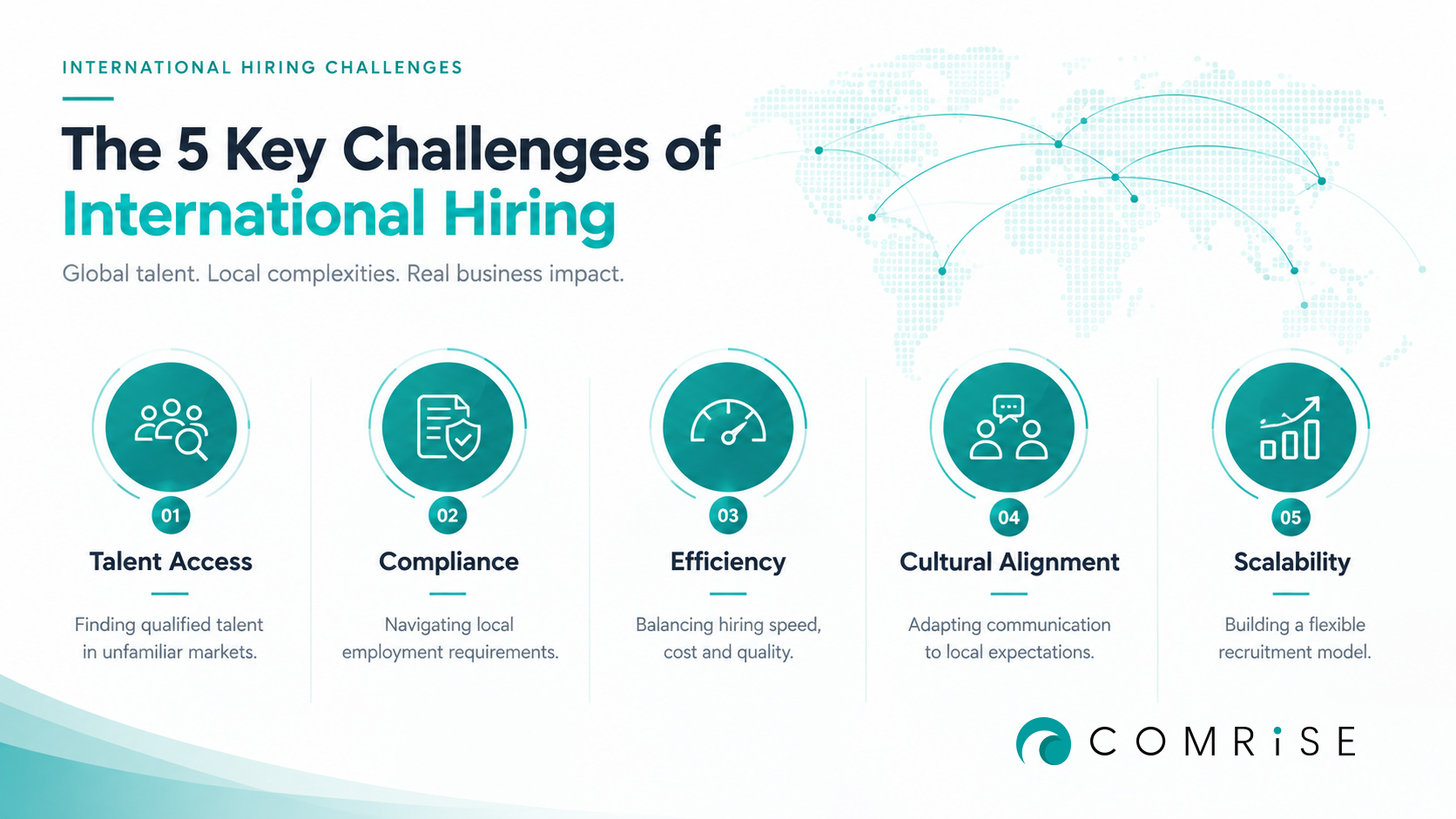
Expanding into international markets creates new opportunities for growth, but hiring the right talent across borders is rarely as simple as posting a job in another country. From navigating local labor markets to managing compliance, candidate expectations, and recruitment efficiency, global employers must solve several interconnected challenges before they can build a workforce that supports sustainable expansion.
As businesses expand across regions, international hiring is becoming a strategic capability rather than a standalone recruitment activity. The key is not simply to access more candidates, but to identify the right talent, navigate local market complexities, and build a recruitment process that can scale with business needs.
In this article, we explore five common international hiring challenges and practical ways employers can address them.
1. Accessing the Right Talent in Unfamiliar Markets
One of the first challenges in international hiring is understanding where qualified talent is available and how to reach it.
A company may have a clear understanding of the role it needs to fill, yet lack visibility into the local talent landscape. Candidate availability, compensation expectations, recruitment channels, and competition for specialized skills can vary significantly from one market to another.
This is particularly relevant for roles in technology, engineering, advanced manufacturing, and other specialized fields, where the required capabilities may be concentrated in specific locations.
How to address it:
-
Map talent availability before hiring: Assess target markets based on relevant skills, candidate supply, compensation benchmarks, and hiring feasibility.
-
Localize sourcing strategies: Use recruitment channels and professional networks that are effective in each market.
-
Build proactive talent pipelines: Develop relationships with qualified candidates before urgent vacancies arise.
-
Prioritize skills over geography alone: Evaluate candidates against role requirements and demonstrated capabilities rather than relying exclusively on familiar talent pools.
A well-informed sourcing strategy helps employers broaden their reach without sacrificing candidate quality.
2. Navigating Different Employment Regulations and Hiring Requirements
International recruitment involves more than finding a qualified candidate. Employers must also understand the employment requirements that apply in the country where the individual will work.
Local rules governing employment contracts, work authorization, compensation, benefits, working hours, and termination can differ substantially across jurisdictions. Depending on the role and hiring arrangement, immigration requirements and other regulatory obligations may also apply.
For companies entering a new market, unfamiliar requirements can create delays, increase administrative workloads, and introduce avoidable risks.
How to address it:
-
Identify the applicable employment and work authorization requirements early in the recruitment process.
-
Work with qualified local HR, legal, and compliance professionals when interpreting jurisdiction-specific obligations.
-
Clarify the appropriate hiring model, whether through an established local entity or another legally suitable arrangement.
-
Establish clear ownership of compliance checks, documentation, and onboarding responsibilities.
Compliance should be integrated into international workforce planning from the beginning, rather than treated as a final checkpoint after a candidate has been selected.
Note: Employment requirements vary by jurisdiction and change over time. Employers should obtain appropriate local professional advice before making hiring decisions.
3. Balancing Hiring Speed, Cost, and Candidate Quality
International hiring often involves multiple stakeholders, recruitment channels, interview schedules, and approval processes. When these activities are managed independently across different markets, hiring can become fragmented and difficult to control.
The result may be longer recruitment cycles, duplicated sourcing efforts, inconsistent candidate assessments, and higher costs per hire.
Moving faster does not necessarily solve the problem. Accelerating recruitment without consistent evaluation standards can compromise hiring quality, while overly complex processes may cause strong candidates to disengage before an offer is made.
How to address it:
-
Standardize the core recruitment workflow: Establish clear stages, responsibilities, and decision criteria across markets.
-
Localize where necessary: Adapt sourcing, communication, and assessment methods to local market conditions.
-
Improve stakeholder coordination: Align hiring managers, recruiters, and regional teams on role requirements and decision timelines.
-
Track meaningful recruitment metrics: Monitor time-to-hire, cost-per-hire, interview conversion, offer acceptance, and quality of hire.
The objective is not to impose an identical process on every country. It is to create a consistent operating framework that allows local teams to work effectively while maintaining visibility across the organization.
4. Overcoming Cultural and Communication Barriers
A candidate who performs well in one market may have different expectations regarding communication, compensation, career development, management style, or workplace flexibility in another.
These differences can affect how candidates evaluate an employer and how effectively recruitment teams engage with them.
Communication challenges may also emerge when hiring managers and recruiters work across time zones, use different business conventions, or interpret role requirements differently.
Without a thoughtful localization strategy, companies risk losing qualified candidates because their recruitment experience does not reflect local expectations.
How to address it:
-
Adapt employer messaging to the motivations and expectations of local talent.
-
Establish clear communication standards across time zones and regional teams.
-
Use structured interviews and consistent evaluation criteria to reduce misunderstandings and subjective decision-making.
-
Communicate compensation structures, responsibilities, reporting lines, and career opportunities transparently.
-
Prepare hiring managers to work effectively with culturally diverse teams.
A strong international recruitment strategy combines global consistency with local understanding. Candidates should recognize the same employer values while receiving a recruitment experience relevant to their market.
5. Scaling International Recruitment Without Increasing Operational Complexity
Successfully filling a few international positions is different from supporting sustained hiring across multiple countries.
As businesses expand, recruitment demand may fluctuate by market, business unit, and skill category. Internal HR teams can struggle to maintain sufficient sourcing capacity, local market knowledge, and consistent delivery standards across every location.
Building a large in-house recruitment function in every market may not be practical, particularly when hiring volumes are uncertain or expansion is still in its early stages.
This creates a need for more flexible and scalable recruitment operating models.
How to address it:
-
Match recruitment capacity to business demand: Assess whether direct hiring, recruitment process outsourcing (RPO), specialist search, or a combination of models best fits each requirement.
-
Leverage regional delivery capabilities: Work with recruitment partners that understand local markets and can support hiring across multiple locations.
-
Use technology to improve efficiency: Apply appropriate AI-enabled tools to support job description analysis, candidate sourcing, resume screening, and recruitment workflow management.
-
Maintain consistent performance visibility: Use shared reporting and agreed service metrics to monitor progress, quality, and delivery outcomes.
-
Review the model as the business evolves: Adjust sourcing capacity, recruitment support, and market coverage as hiring needs change.
Technology can improve the efficiency of repetitive recruitment activities, but it should complement rather than replace professional judgment. Human oversight remains essential for evaluating candidates, managing stakeholder relationships, and making responsible hiring decisions.
The most effective model is one that balances delivery capacity, local expertise, cost control, and hiring quality.
From International Hiring Challenges to a Scalable Talent Strategy
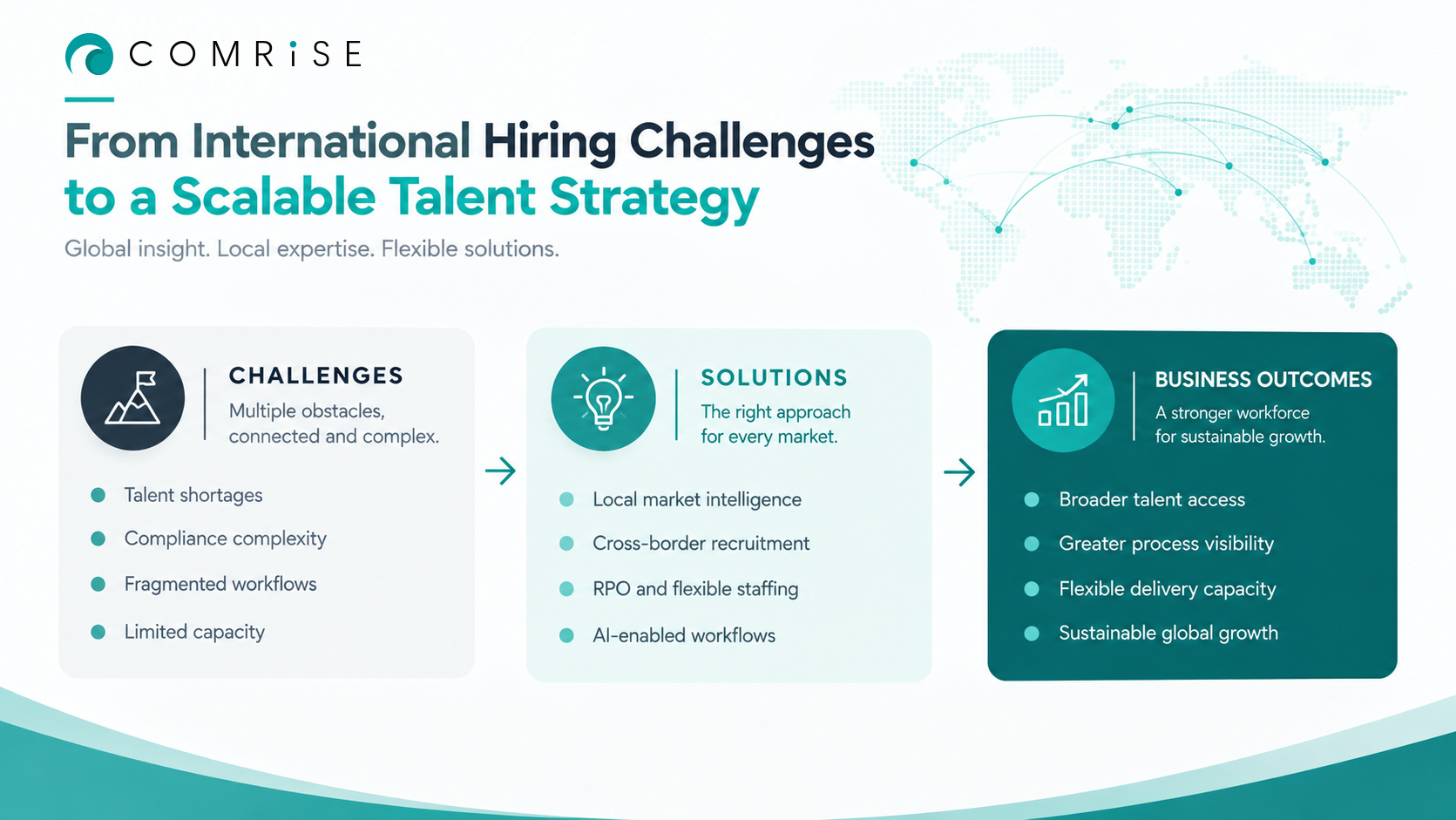
International hiring challenges rarely occur in isolation. Limited talent visibility can slow sourcing. Unfamiliar regulations can delay decisions. Fragmented workflows can increase costs. Cultural misunderstandings can weaken candidate engagement. And insufficient recruitment capacity can make expansion difficult to sustain.
Addressing these issues requires a coordinated approach that connects talent strategy, local market intelligence, recruitment delivery, and workforce planning.
Before expanding hiring into a new market, employers should ask five practical questions:
-
Where can we find the talent and capabilities our business needs?
-
What local employment requirements must we address?
-
How will we balance hiring speed, cost, and quality?
-
How should our recruitment approach adapt to local candidate expectations?
-
Can our recruitment operating model support future growth without creating unnecessary complexity?
Clear answers to these questions help organizations move beyond reactive hiring toward a more structured and sustainable approach to global talent acquisition.
How Comrise Supports International Hiring
Building an international workforce requires more than access to candidates. It requires the ability to connect local market knowledge, effective recruitment delivery, and business objectives across regions.
è®¯å‡ supports organizations with global talent acquisition and flexible workforce solutions, helping businesses address recruitment needs across markets and hiring requirements.
Our capabilities include:
-
Cross-Border Talent Acquisition: Recruitment support for organizations seeking qualified talent across international markets.
-
Professional and Executive Search: Targeted talent identification for specialized, mid-level, and senior-level positions.
-
Recruitment Process Outsourcing (RPO): Scalable recruitment delivery that helps organizations manage hiring demand and improve process consistency.
-
Flexible Staffing Solutions: Workforce support aligned with changing business requirements.
-
AI-Enabled Recruitment: Technology-assisted workflows that support sourcing, candidate evaluation, and recruitment efficiency, complemented by recruiter expertise.
With a global delivery perspective and an understanding of local recruitment needs, Comrise helps organizations approach international hiring with greater clarity, flexibility, and operational discipline.
Planning to hire across borders?
Whether you are entering a new market, building a regional team, or scaling recruitment across multiple locations, the right talent strategy can make a meaningful difference.
Contact Comrise at marketing@comrise.com to discuss your international hiring needs.
Together, let’s build a workforce ready for global growth.