Hiring in Malaysia in 2026: Where Are the Biggest Talent Gaps?
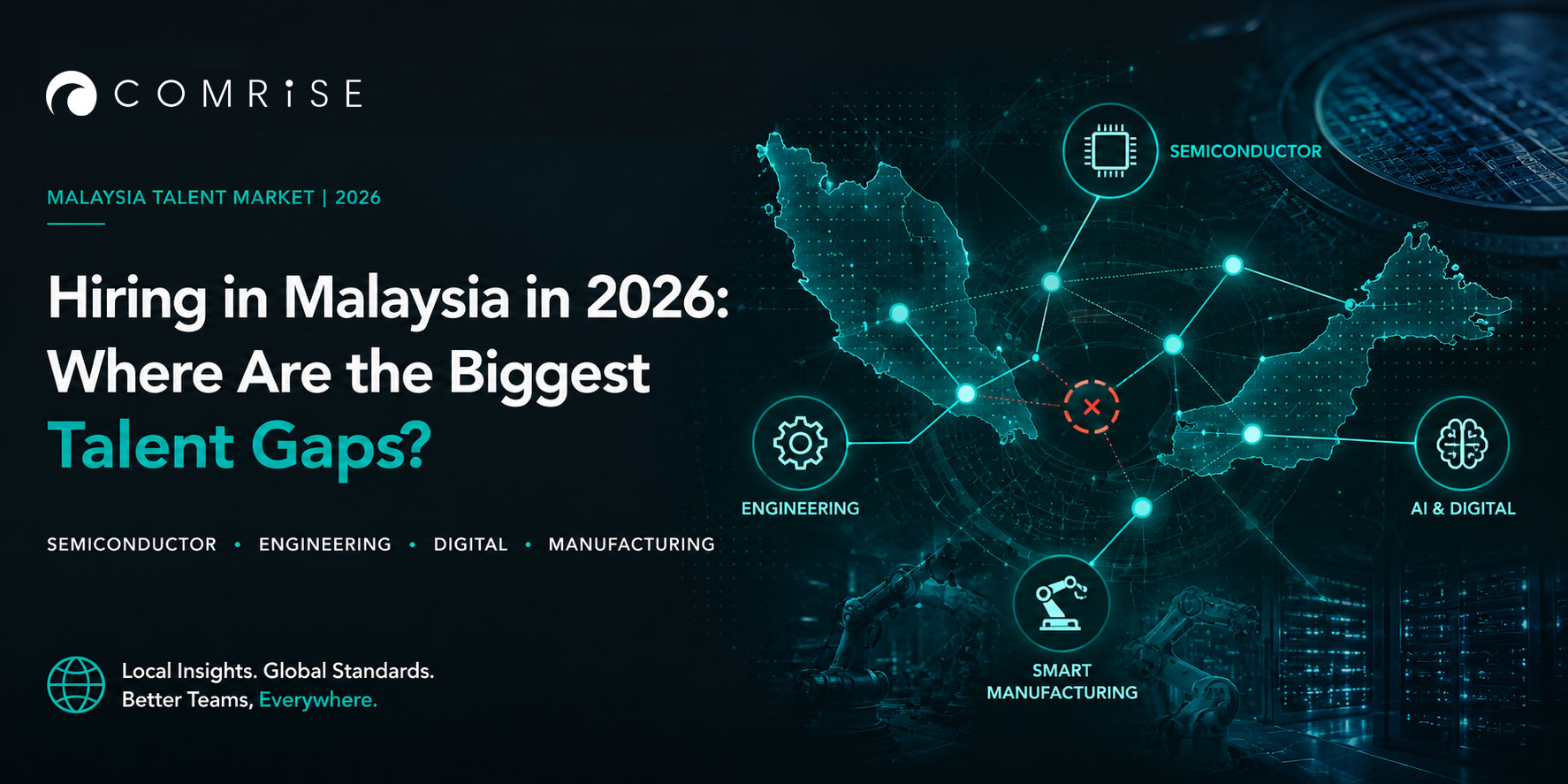
Hiring in Malaysia in 2026 is becoming increasingly competitive as companies face growing shortages in semiconductor, engineering, digital, and other specialized talent. As Malaysia attracts more investment in high-value manufacturing, technology, data centers, and digital infrastructure, employers are competing for professionals with increasingly specialized skills.
For global companies expanding into Malaysia, this creates a critical workforce challenge.
The question is no longer simply “Where can we find candidates?”
It is:
“Where can we find the right capabilities to support our growth?”
Malaysia remains one of Southeast Asia’s most attractive destinations for global companies. Its established manufacturing ecosystem, strategic location, relatively strong infrastructure, and growing digital economy continue to attract multinational companies and regional investments.
At the same time, the country’s workforce is undergoing a significant transformation.
As businesses move from traditional manufacturing and support functions toward semiconductor, advanced manufacturing, AI, data, automation, and digital operations, demand for specialized professionals is growing faster than the available talent pool in several areas.
For companies planning to build teams in Malaysia, understanding these talent gaps is becoming an essential part of workforce strategy.
Why Hiring in Malaysia Is Becoming More Challenging in 2026
Malaysia has long been an important manufacturing and electronics hub in Southeast Asia.
However, the nature of investment is changing.
Companies are increasingly looking beyond labor-intensive operations and building capabilities in areas such as:
-
Semiconductor and advanced electronics
-
Engineering and R&D
-
Artificial intelligence and data
-
Cloud and digital infrastructure
-
Smart manufacturing
-
Automation and robotics
-
Regional technology and business operations
This shift is creating a more specialized labor market.
The challenge is therefore not necessarily a lack of people overall. Instead, employers are facing a skills mismatch between the capabilities companies need and the experience available in the market.
This distinction is particularly important for international companies.
A company may receive hundreds of applications for a technical position while still struggling to identify candidates who have the right combination of industry experience, technical expertise, leadership capability, and local market knowledge.
As a result, hiring timelines can become longer, competition for experienced professionals can increase, and employers may need to rethink how they approach talent acquisition.
What Are the Biggest Talent Gaps When Hiring in Malaysia?
The most significant talent gaps are concentrated in several high-value sectors.
While the exact demand varies by industry and location, four areas are particularly important for companies building teams in Malaysia in 2026.
1. Semiconductor and Electronics Engineering Talent
Malaysia has a long-established position in the global semiconductor and electronics supply chain.
The country is now working to move further up the value chain, creating greater demand for specialized engineering and technical professionals.
Companies are increasingly looking for talent in areas such as:
-
Semiconductor process engineering
-
IC design
-
Equipment engineering
-
Test engineering
-
Quality and reliability engineering
-
Advanced packaging
-
Semiconductor manufacturing
-
Automation and industrial engineering
The challenge is especially significant for positions requiring several years of specialized industry experience.
Entry-level engineering graduates may be relatively accessible, but experienced professionals who can immediately contribute to advanced manufacturing, process optimization, equipment management, or semiconductor technology are more difficult to secure.
This creates strong competition among semiconductor manufacturers, electronics companies, and other technology-driven employers.
For global companies entering Malaysia, relying exclusively on job advertisements may therefore produce limited results.
Targeted sourcing and access to passive candidates can become much more important.
2. Digital, AI, and Technology Talent
Digital transformation is creating another major source of hiring pressure.
Across industries, Malaysian companies are increasing their demand for professionals with capabilities in:
-
Artificial intelligence
-
Data analytics
-
Software development
-
云计算
-
Cybersecurity
-
IT infrastructure
-
Digital transformation
-
Enterprise technology
However, digital hiring presents a different challenge from traditional recruitment.
Technology changes faster than many traditional education and training systems.
A candidate may have an appropriate academic background but lack the practical experience required to implement AI, cloud, cybersecurity, or data solutions in a business environment.
This means companies increasingly need to evaluate candidates based on skills and demonstrated capabilities, rather than qualifications alone.
For global employers, this can make the talent search significantly more complex.
The most valuable candidates are often already employed, have multiple opportunities available, and are selective about changing companies.
3. Smart Manufacturing and Automation Specialists
Malaysia’s manufacturing sector is becoming increasingly technology-driven.
Factories are adopting automation, connected production systems, robotics, industrial data platforms, and other Industry 4.0 technologies.
As a result, demand is increasing for professionals who can combine traditional engineering knowledge with digital and automation capabilities.
Key roles include:
-
Automation engineers
-
Robotics engineers
-
Controls engineers
-
PLC specialists
-
Manufacturing engineers
-
Industrial engineers
-
Production technology specialists
-
Manufacturing data analysts
-
Digital manufacturing managers
The most difficult profiles are often those that combine multiple skill sets.
For example, a manufacturing engineer who understands both production processes and industrial automation may be considerably more difficult to find than a candidate with experience in only one area.
This creates a growing need for companies to define their requirements carefully before beginning recruitment.
Overly narrow job descriptions can reduce the available talent pool, while overly broad requirements can make candidate selection inefficient.
4. Experienced Technical and Leadership Talent
Another challenge when hiring in Malaysia is the availability of experienced mid-to-senior professionals.
Global companies establishing or expanding Malaysian operations often need people who can do more than perform a technical function.
They may need leaders who can:
-
Establish local operations
-
Build and manage teams
-
Implement global processes
-
Work with regional headquarters
-
Manage local stakeholders
-
Develop local talent
-
Scale operations
These professionals are particularly valuable during the early stages of market entry.
However, experienced managers and technical leaders are often already working for multinational companies or established local employers.
This creates a relatively small and competitive talent pool.
For international companies, the challenge is therefore not simply identifying qualified candidates.
It is convincing the right candidates to consider a new opportunity.
Why Are Malaysia Talent Shortages Becoming a Bigger Problem for Global Companies?
Talent shortages become particularly challenging when companies are entering a market for the first time.
There are three common reasons.
Limited Access to Specialized Talent Pools
Highly experienced technical professionals are often passive candidates.
They may not actively apply for positions through conventional job boards.
Companies that rely only on inbound applications can therefore miss a significant part of the available talent market.
A more effective approach may combine:
-
Direct sourcing
-
Passive candidate engagement
-
Industry networks
-
Local talent databases
-
Professional communities
-
Employee referrals
Strong Competition for the Same Skills
Companies across different industries may compete for the same professionals.
For example, an automation engineer could potentially work for:
-
Semiconductor companies
-
Electronics manufacturers
-
Automotive companies
-
Industrial manufacturers
-
Technology companies
This means competition is no longer limited to companies within the same industry.
Employers need to understand what candidates value beyond salary, including career development, technical exposure, management quality, flexibility, and long-term growth opportunities.
Lack of Local Recruitment Intelligence
International companies may understand their global workforce strategy but lack detailed knowledge of the Malaysian talent market.
Important questions include:
-
Where is the relevant talent concentrated?
-
Which companies employ similar professionals?
-
What are current salary expectations?
-
How competitive is the market for a particular role?
-
How long does it typically take to hire?
-
Which positions should be localized?
-
Which positions may require regional or international talent?
Without this information, companies can easily design unrealistic hiring plans.
What Should Global Companies Do Differently When Hiring in Malaysia?
Addressing Malaysia’s talent gaps requires more than increasing recruitment volume.
Companies need to move toward a more strategic approach to talent acquisition.
1. Start With Talent Mapping, Not Job Posting
Before opening a position, companies should understand the available talent market.
A talent mapping exercise can help identify:
-
Target companies
-
Relevant talent pools
-
Key locations
-
Salary benchmarks
-
Candidate availability
-
Competitor hiring activity
This allows employers to determine whether a hiring target is realistic before investing significant recruitment resources.
2. Prioritize Skills Over Overly Rigid Job Requirements
When talent is scarce, overly restrictive job descriptions can make hiring even more difficult.
Companies should distinguish between:
Must-have capabilities
and
Skills that can be developed after hiring.
For example, a candidate may have strong manufacturing experience and automation expertise but lack experience with a specific software platform.
If the underlying capabilities are transferable, the candidate may still represent a strong hiring opportunity.
A skills-based approach can significantly expand the available talent pool.
3. Build a Local Talent Pipeline
For companies with long-term operations in Malaysia, recruitment should not be treated as a series of individual vacancies.
A sustainable workforce strategy may include:
-
Graduate recruitment
-
University partnerships
-
Internship programs
-
Technical training
-
Internal mobility
-
Upskilling and reskilling
-
Local leadership development
This is particularly important for semiconductor, manufacturing, engineering, and technology companies where specialized talent takes time to develop.
4. Use Local Recruitment Expertise
Global recruitment strategies do not always translate directly into local markets.
A local recruitment partner can provide market intelligence that is difficult to obtain from outside the country.
This can include:
-
Local salary insights
-
Candidate availability
-
Industry talent mapping
-
Passive candidate sourcing
-
Recruitment market intelligence
-
Local hiring practices
For companies entering Malaysia for the first time, this can reduce both hiring risk and time-to-market.
How Comrise Helps Global Companies Build Teams in Malaysia
Building a team in Malaysia requires more than access to candidates.
Companies need a combination of market intelligence, recruitment capability, and workforce strategy.
Comrise helps global companies navigate the Malaysian talent market through localized recruitment and cross-border workforce solutions.
Our capabilities include:
-
Local Talent Intelligence — Understanding talent availability, market dynamics, and hiring conditions.
-
Technical & Engineering Recruitment — Identifying specialized engineering and technical professionals.
-
Semiconductor & Manufacturing Hiring — Supporting companies building teams in high-demand industrial sectors.
-
Executive & Specialist Search — Helping companies identify experienced leaders and hard-to-find professionals.
-
Cross-Border Workforce Solutions — Supporting global companies as they build and scale teams across markets.
Whether a company is establishing its first Malaysian team or expanding an existing operation, the right hiring strategy can make the difference between simply filling positions and building the capabilities needed for long-term growth.
The Future of Hiring in Malaysia: From Talent Availability to Talent Strategy
Malaysia’s talent market is entering a new phase.
As investment continues to move toward semiconductors, advanced manufacturing, digital technology, AI, and other high-value industries, demand for specialized skills is likely to remain strong.
For employers, this means the traditional approach of posting jobs and waiting for applications is becoming less effective.
The companies that build competitive teams will be those that understand where talent exists, identify transferable skills, engage passive candidates, and develop long-term talent pipelines.
Hiring in Malaysia in 2026 is not simply about finding more people.
It is about building the right capabilities for the next stage of growth.
For global companies expanding into Malaysia, that shift makes talent strategy just as important as recruitment execution.
Looking to build your team in Malaysia?
Connect with è®¯å‡ to explore local talent insights and recruitment solutions for your Malaysia expansion.