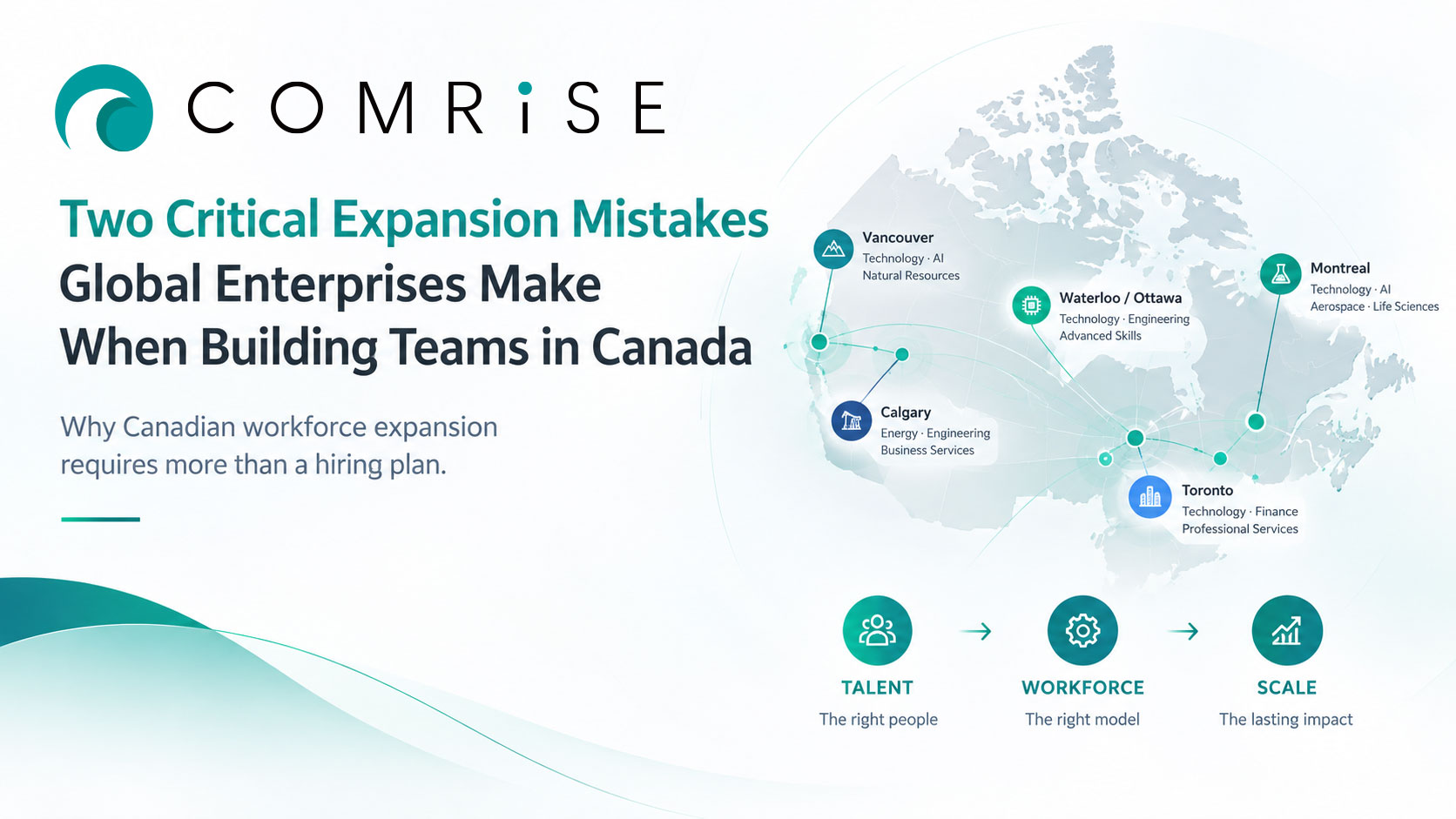
Two Critical Expansion Mistakes Global Enterprises Make When Building Teams in Canada
For global enterprises expanding into Canada, building teams in Canada can appear straightforward: establish an entity, define headcount, open positions, and start recruiting.
In practice, successful workforce expansion requires much more than filling vacancies.
Canada offers access to highly skilled talent across technology, engineering, finance, life sciences, manufacturing, and other sectors. But talent availability, compensation expectations, employment requirements, and workforce dynamics can vary significantly across locations and industries.
For global companies, the biggest challenge is often not finding candidates. Building teams in Canada requires a workforce strategy that fits the Canadian market while remaining aligned with global business objectives.
Two mistakes are particularly common.
Mistake 1: Treating Canada as One Homogeneous Talent Market
One of the first mistakes global enterprises make is assuming that a single national hiring strategy will work equally well across Canada.
The reality is more nuanced.
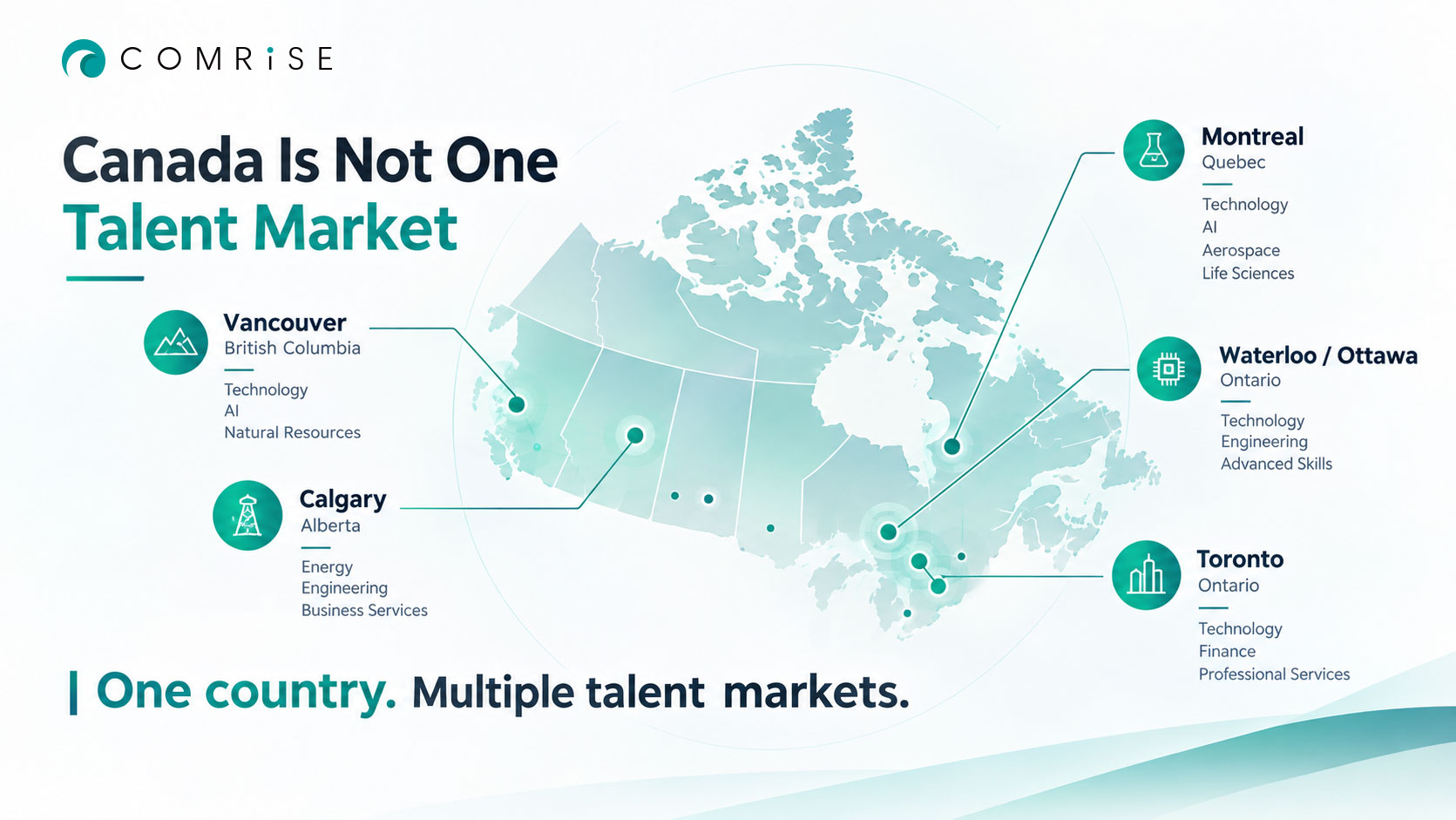
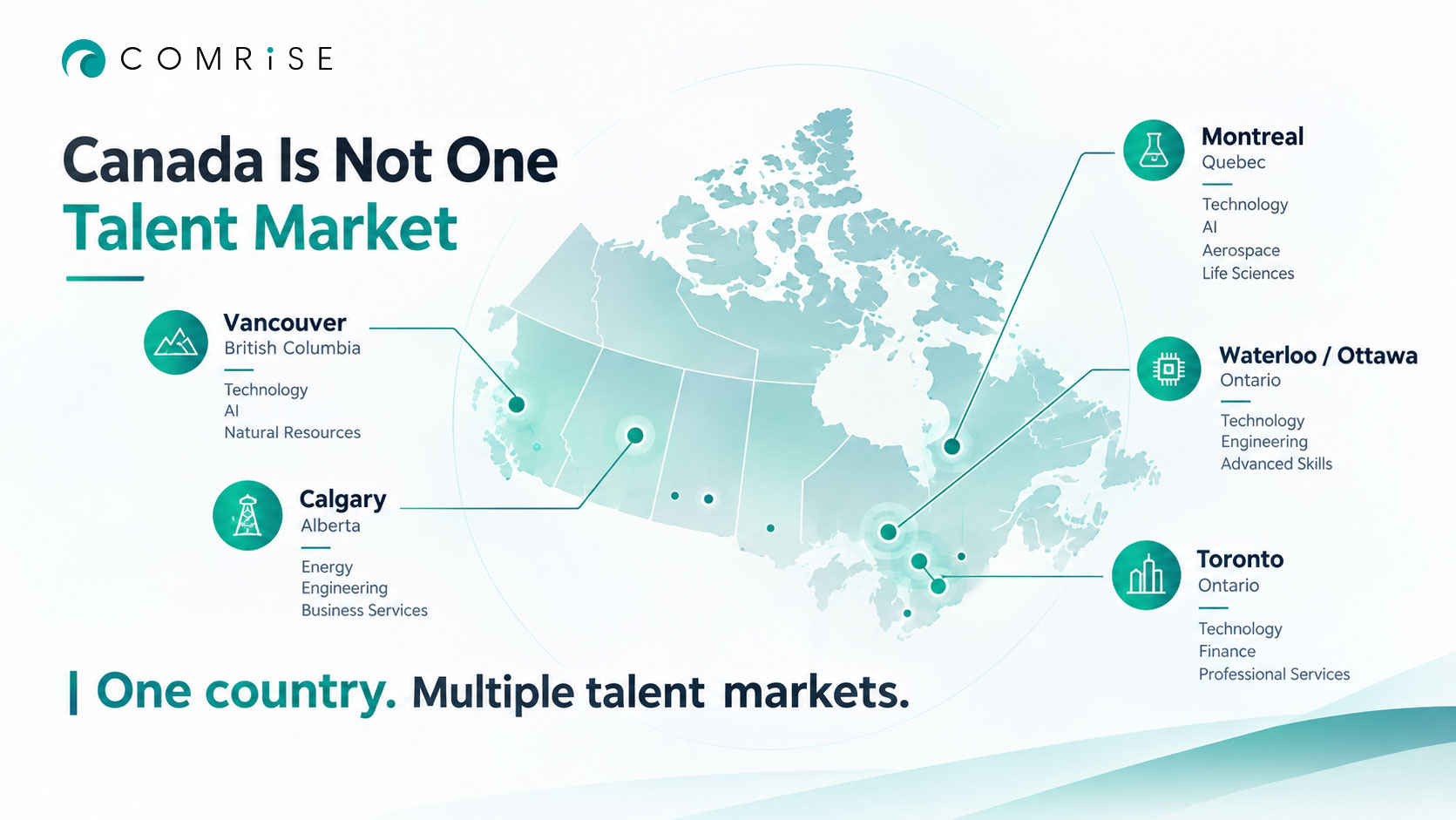
Toronto, Vancouver, Montreal, Calgary, Ottawa, Waterloo, and other Canadian talent markets have different industry concentrations, talent pools, compensation dynamics, and candidate expectations.
A company looking for software engineers may find a very different competitive environment in Toronto than in Calgary. A manufacturing organization may need to evaluate talent availability around specific industrial clusters rather than simply hiring near its corporate office.
The result is a simple but important principle:
Where the business is located is not always where the talent is.
Talent availability varies by location
Before opening a position, global enterprises should understand where relevant talent is concentrated.
A Canada talent strategy should consider:
- Where critical skills are available
- Which employers are competing for the same talent
- How candidate supply differs by location
- Whether roles can be supported through remote or hybrid models
- Which locations provide a sustainable talent pipeline
This is particularly important for specialized roles.
For example, a company expanding its engineering organization may initially plan to build its team around one office. A broader talent-market analysis may reveal that a hybrid workforce across multiple Canadian locations provides access to a deeper and more diverse talent pool.
Compensation cannot simply be copied from another market
Another common problem is transferring an existing global compensation benchmark directly into Canada.
A compensation package that is competitive in another country may not have the same impact in the Canadian market.
Candidates evaluate more than base salary. Depending on the role and market, expectations can also include benefits, flexibility, career development, workplace culture, and other elements of the overall employment proposition.
For certain roles involving temporary foreign workers, employers must also consider applicable wage requirements and program conditions.
This makes local market intelligence an important part of workforce planning—not simply a recruitment activity.
Employment requirements need to be considered early
Global enterprises also need to recognize that Canada’s employment environment involves federal, provincial, and territorial considerations.
Employment standards can differ depending on the jurisdiction and the nature of the workforce.
For companies entering the market, compliance should therefore not be treated as paperwork that happens after a hiring decision.
It should be part of the workforce design process from the beginning.
Location → Talent availability → Compensation → Employment model → Hiring process → Compliance
The earlier these factors are evaluated together, the easier it becomes to build a sustainable Canadian team.
Mistake 2: Focusing on Headcount Instead of Workforce Design
The second mistake is even more fundamental.
When entering a new market, leadership teams often start with a headcount question:
“How many people do we need?”
A better question is:
“What workforce model do we need?”
Headcount is an output of workforce strategy—not the strategy itself.
A global enterprise building teams in Canada may need different workforce models at different stages of expansion.
Market Entry: Start with the capabilities the business actually needs
During the initial market-entry phase, the company may not need a large organization.
The immediate requirements could include:
- Business development leadership
- Market development
- Finance and operations support
- HR capabilities
- A small number of highly specialized professionals
At this stage, building a full organizational structure too early can create unnecessary cost and operational complexity.
The objective should be to establish the capabilities required to validate and develop the Canadian business.
Build: Develop the core team
Once the business demonstrates traction, the workforce model can evolve.
The company may gradually build functional capabilities across:
- Sales
- Engineering
- Operations
- Customer support
- 金èž
- Human resources
- Leadership
At this point, recruitment becomes less about individual vacancies and more about creating an organizational structure that can support growth.
Scale: Build a repeatable talent engine
As hiring volume increases, companies often discover that their original recruitment approach cannot scale.
A small internal team may be able to manage ten or twenty hires. It becomes much more difficult when the organization needs to recruit across multiple functions, locations, and seniority levels simultaneously.
This is where organizations may consider solutions such as Recruitment Process Outsourcing (RPO), flexible staffing, talent mapping, or other workforce models.
The goal is not simply to increase recruiting capacity.
It is to create a repeatable process for:
Talent sourcing → Candidate engagement → Assessment → Hiring → Onboarding → Workforce planning
Optimize: Build a sustainable Canadian workforce
Once the Canadian operation reaches maturity, the focus shifts again.
Leadership needs to ask:
- Are we attracting the right talent?
- Are critical skills becoming harder to access?
- Is our workforce structure cost-effective?
- Where should future hiring take place?
- Which capabilities should remain internal?
- Where can flexible workforce models provide greater agility?
- How can we improve retention?
At this stage, workforce strategy becomes an ongoing business capability rather than a one-time expansion project.
The New Question for Global Enterprises
The traditional expansion model is often linear:
Office → Headcount → Recruitment → Hiring
A more effective model is strategic:
Business Strategy → Workforce Design → Talent Market Intelligence → Hiring Model → Local Execution → Continuous Optimization
This shift matters because the best workforce model may not look the same in every country.
A global enterprise may maintain consistent standards for employer branding, governance, technology, and reporting while adapting talent acquisition and workforce execution to the local market.
In other words:
Global standards should create consistency. Local intelligence should create effectiveness.
A Smarter Framework for Building Teams in Canada
For companies planning or accelerating Canadian expansion, four questions can provide a stronger starting point.
1. Where is the talent?
Map the Canadian talent market before deciding where and how to recruit.
Understand talent concentration, competitor activity, skill availability, compensation expectations, and candidate behavior.
2. What capabilities are needed now?
Separate immediate business-critical capabilities from longer-term organizational requirements.
Not every position needs to be hired at the same time or through the same model.
3. Which workforce model fits each stage?
Consider the appropriate combination of permanent hiring, RPO, flexible staffing, talent mobility, internal transfers, and other workforce solutions.
The objective is to match workforce structure with business maturity.
4. How will the model scale?
A successful Canadian expansion should not depend entirely on individual recruiters or ad hoc hiring.
Companies need processes, data, talent pipelines, and local market expertise that can support growth over time.
Build the Team Around the Market—Not the Other Way Around
Successful expansion into Canada is not about replicating the workforce model that worked elsewhere.
It is about adapting that model to the market.
For global enterprises, the real competitive advantage comes from combining global workforce strategy with local execution—understanding where talent is available, designing the right workforce structure, and building the flexibility to scale as business needs change.
At Comrise, we help global enterprises build and scale cross-border teams by combining global workforce strategy with local talent-market expertise. From talent mapping and recruitment to RPO, staffing, and broader workforce solutions, we help organizations build the right team for each stage of international expansion.
Planning your next phase of expansion in Canada?
Connect with è®¯å‡ to explore a workforce strategy designed around your business goals and the Canadian talent market.