AI Skills Across 27 Markets: Where Is Your Next Talent Advantage?
AI skills are becoming a global hiring priority—but demand is rising at different speeds across markets. For companies building international teams, understanding where skills are needed most may be just as important as knowing which skills to hire.
Artificial intelligence is changing how organizations develop products, serve customers, analyze information, and make decisions. As adoption accelerates, employers are rethinking not only the technologies they use, but also the capabilities their people need.
Yet the global AI talent landscape is far from uniform.
Some markets already show a high concentration of AI-related requirements in technical job postings. Others are experiencing rapid growth from a lower starting point. At the same time, employers differ in the technical specialties and human capabilities they prioritize.
For companies competing for AI talent, this creates a strategic question: Should you compete for talent in the markets you already know—or explore where the right capabilities are emerging?
1. One Global Trend, 27 Different Market Signals
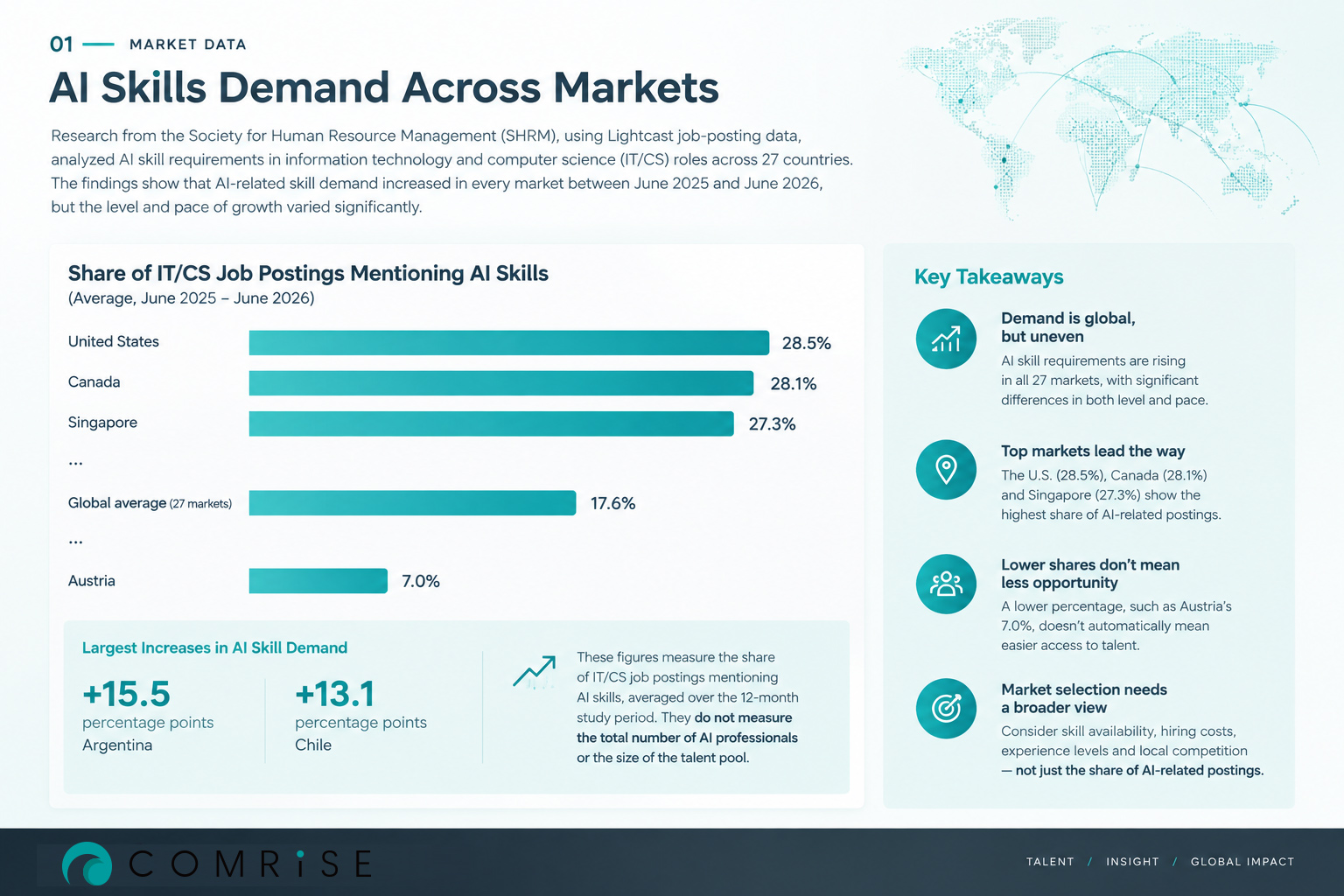
Research from the Society for Human Resource Management (SHRM), using Lightcast job-posting data, analyzed AI skill requirements in information technology and computer science (IT/CS) roles across 27 countries.
The findings reveal a clear pattern: AI-related skill demand increased in every country studied between June 2025 and June 2026, but the level and pace of demand varied significantly.
Key findings include:
-
28.5% in the United States: The highest average share of IT/CS job postings mentioning AI skills among the 27 markets.
-
28.1% in Canada: Nearly matching the United States, indicating a similarly high concentration of AI-related requirements in technical hiring.
-
27.3% in Singapore: A strong signal of AI-related skill demand in a key Southeast Asian business and technology hub.
-
7% in Austria: The lowest average share among the countries studied.
-
15.5 and 13.1 percentage points: The increases recorded by Argentina and Chile, respectively—the largest gains across the 27 markets.
These figures measure the share of IT/CS job postings mentioning AI skills, averaged over the 12-month study period. They do not measure the total number of AI professionals, the size of the talent pool, or the extent of an actual skills shortage.
The strategic implication: A market with a high share of AI-related postings may offer a strong ecosystem of relevant employers and capabilities, but it may also involve intense competition. A market with a lower share should not automatically be considered an easier source of talent. Employers need to assess skills availability, hiring costs, experience levels, and local competition together.
2. Look Beyond the Country: Which Skills Are in Demand?
Geography is only one part of the picture. AI-related hiring requirements also vary considerably by occupation.
SHRM’s analysis found that the median share of postings mentioning AI skills ranged from 4.7% for Network and Systems Support roles to 55.1% for Data Analysis and Mathematics roles across the countries studied.
For specific occupations, the requirements were even more pronounced:
-
Artificial Intelligence Engineers: 93% of postings mentioned AI skills.
-
Data Scientists: 75% of postings mentioned AI skills.
These findings suggest that AI capability is not distributed evenly across technical job families. Employers need to distinguish between roles that build AI systems, roles that work extensively with data, and roles that primarily operate or support technology infrastructure.
The terminology used in job descriptions matters, too. SHRM reported that 60.3% of AI-related postings referenced artificial intelligence generally, while generative AI appeared in 15.3% and AI agents in 13.9%.
For hiring teams, this is a reminder to define the work before defining the search.
A broad requirement such as “AI experience” may attract candidates with very different capabilities. A more effective brief identifies the business problem, technical environment, level of expertise, and expected outcomes.
For example, an organization developing AI-powered products may need machine learning engineers and data scientists. A business integrating generative AI into existing workflows may prioritize AI application development, cloud expertise, data governance, and the ability to translate business needs into practical solutions.
Clearer skill definitions create a stronger foundation for talent mapping, candidate assessment, and cross-border recruitment.
3. AI Talent Is Not Just About Technical Skills
Technical expertise remains essential, but the ability to apply it effectively also matters.
SHRM’s research identified substantial differences in how often AI-related IT/CS job postings mentioned social skills. The share ranged from 5.7% in Australia to 34.3% in France.
These figures reflect differences in job-posting language and employer requirements, rather than a direct measure of workers’ actual capabilities. Nevertheless, they highlight an important consideration for workforce planning: technical and human skills should not be treated as competing priorities.
AI-enabled teams often need people who can evaluate outputs critically, communicate complex ideas, collaborate across functions, and understand business context.
For international organizations, these capabilities become particularly important when teams operate across languages, cultures, time zones, and regulatory environments.
A technically strong candidate may not automatically be the right fit for a role that requires stakeholder management, cross-functional delivery, or customer-facing problem-solving.
This is why an effective AI talent strategy should assess both technical proficiency and the human capabilities required to turn technology into business value.
4. What the Data Means for Global Hiring Strategy
For organizations expanding internationally or accelerating AI adoption, the research points to three practical priorities.
A. Move from Country-Based Hiring to Skills-Based Talent Mapping
Instead of beginning with a preferred location, define the capabilities the business needs and then assess where suitable talent may be found.
A structured talent-mapping exercise can compare markets across several dimensions:
-
Availability of candidates with relevant technical skills and experience
-
Compensation expectations and total hiring costs
-
Competition from local and international employers
-
Language, collaboration, and time-zone requirements
-
Employment regulations and the feasibility of the proposed hiring model
This approach helps organizations avoid relying on assumptions about which countries are “best” for AI recruitment. Market selection should follow evidence and business requirements—not geography alone.
B. Match the Hiring Model to the Business Need
Not every AI capability needs to be built through permanent, in-house recruitment in a single country.
Depending on the role, timeline, and operating model, organizations may consider several approaches:
-
Direct recruitment: Build long-term internal capability for strategic or business-critical roles.
-
Regional talent hubs: Establish teams in markets that align with business operations, collaboration needs, and talent availability.
-
Recruitment Process Outsourcing (RPO): Extend recruitment capacity and standardize hiring delivery when demand is sustained or hiring volumes increase.
-
Global Staffing and flexible talent models: Access specialized capabilities for defined projects or changing workforce requirements, where legally and operationally appropriate.
-
Business Process Outsourcing (BPO): Support suitable operational processes through a managed service model, allowing internal teams to focus on core priorities.
The right approach depends on the organization’s objectives, not simply on the popularity of a particular hiring model.
For example, a company entering a new market may need local commercial and technical leadership, while an established business scaling an AI implementation may require a broader pipeline of engineers and data specialists. Each scenario calls for a different combination of talent, delivery capacity, and workforce structure.
C. Combine Hiring with Workforce Development
External recruitment is only one part of building AI capability.
Where demand is rising faster than an organization can recruit, workforce planning should also identify adjacent skills, assess internal mobility opportunities, and determine where training or reskilling can close the gap.
Employers can begin by mapping existing employee capabilities against future role requirements, identifying transferable skills, and creating targeted development plans.
This does not eliminate the need for external hiring. Instead, it helps organizations make more deliberate decisions about which capabilities to build internally, which to acquire, and which to access through external partners.
A balanced strategy can reduce overdependence on a narrow talent pool while supporting longer-term workforce resilience.
5. A Practical Framework for Building an AI Talent Strategy
Before launching an international AI recruitment initiative, business and HR leaders can work through five questions:
a. What business outcome are we hiring for?
Define the product, process, or operational challenge the role must address. Translate the objective into measurable responsibilities and required skills.
b. Which capabilities are essential from day one?
Separate must-have technical expertise from skills that can be developed after hiring. This helps prevent unnecessarily restrictive job descriptions.
c. Which markets offer the best overall fit?
Compare talent availability, competition, cost, time-zone alignment, language needs, and regulatory considerations. Use job-posting data as one signal—not as a substitute for local market research.
d. Which workforce model fits the timeline and scale?
Determine whether direct hiring, regional team building, RPO, flexible staffing, or a combination of models best supports the business plan.
e. How will we measure success?
Track indicators such as time to fill, qualified-candidate conversion, cost per hire, offer acceptance, retention, and time to productivity. For larger programs, review performance by role and market to identify where the recruitment strategy needs adjustment.
Together, these steps turn global AI talent acquisition from a reactive search for candidates into a structured workforce-planning process.
6. From Global Talent Access to Strategic Advantage
The rise of AI skills is a global trend, but there is no single global talent market.
The 27-country findings show that employer demand differs by location, occupation, and skill category. For international businesses, the opportunity lies in understanding these differences and translating them into better decisions about where to hire, what to prioritize, and how to organize talent across borders.
That requires more than access to job boards or a list of potential candidates. It calls for reliable market intelligence, well-defined skill requirements, local market understanding, and a recruitment model aligned with business goals.
At 讯å‡, we help organizations navigate cross-border talent needs through global recruitment, talent solutions, RPO, and flexible workforce support. By combining market insight with recruitment execution, businesses can make more informed decisions about building teams across markets.
The question is no longer simply where AI talent is located. It is where your organization can build the capabilities it needs—and how to access them effectively.
Where is your next AI talent market?
Explore how Comrise can support your global hiring strategy.
Contact us: marketing@comrise.com
Sources
-
Society for Human Resource Management (SHRM), Global AI Skills Trends: IT and Computer Science, June 16, 2026. Read the research
-
SHRM, SHRM Research Finds Global Demand for AI Skills Is Rising but Uneven, September 22, 2026. Read the research summary
Data note: The statistics in this article refer to active IT and computer science job postings across 27 countries. The study compares July 2025–June 2026 with the preceding 12-month period. Job-posting shares indicate advertised skill requirements, not the total number of qualified workers or a direct measurement of talent shortages.