Why AI Didn’t Fix Your Hiring Problems: The Missing Link Between Technology and Talent Strategy
AI has changed hiring faster than many organizations expected.
From candidate sourcing and resume screening to interview scheduling and recruitment analytics, AI can automate repetitive tasks, process large volumes of data and help recruiters work more efficiently.
Yet many companies still face the same hiring challenges: critical roles remain open, candidate quality is inconsistent, and skills gaps continue to grow.
So why hasn’t AI solved the hiring problem?
Because hiring is not only a technology problem. It is a talent strategy problem.
AI can make recruitment faster. But without a clear understanding of what talent the business actually needs, technology may simply make an inefficient hiring process move faster.
AI Can Make Hiring Faster. But Faster Isn’t Always Better.
AI is already becoming part of everyday recruitment.
LinkedIn’s 2026 research found that 93% of recruiters plan to increase their use of AI in 2026, while 59% say AI is already helping them identify candidates with skills they might otherwise have missed.
But greater AI adoption does not automatically mean better hiring outcomes.
The real question is not:
“Can AI help us process more candidates?”
It is:
“Are we identifying the right candidates for the capabilities our business actually needs?”
A company can screen thousands of resumes in minutes and still fail to fill a critical role.
That is the difference between process efficiency and talent strategy.
The Real Hiring Problem Often Starts Before the Job Goes Live
Many hiring problems begin before recruiters ever start searching.
Consider this sequence:
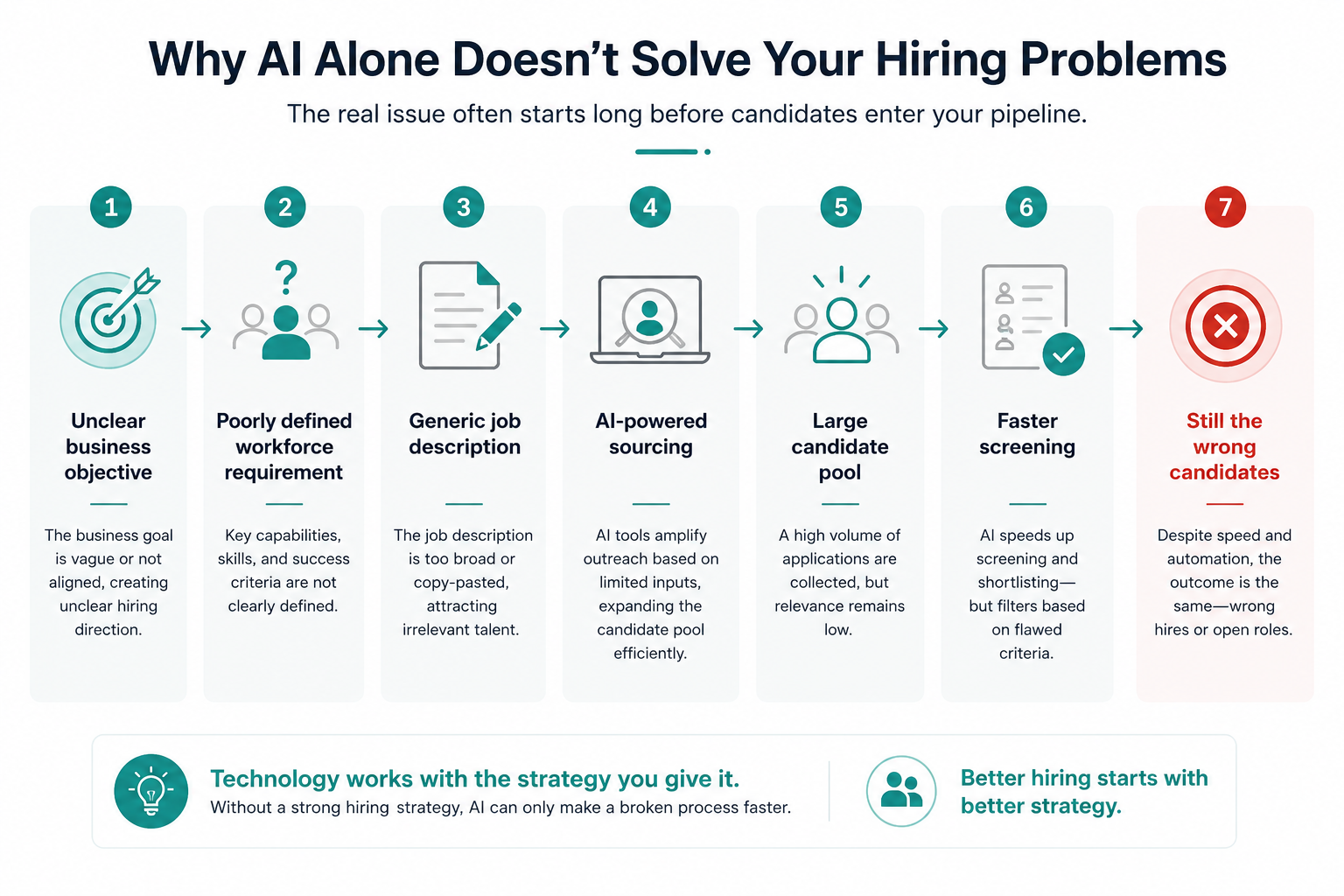
The technology worked.
The hiring strategy didn’t.
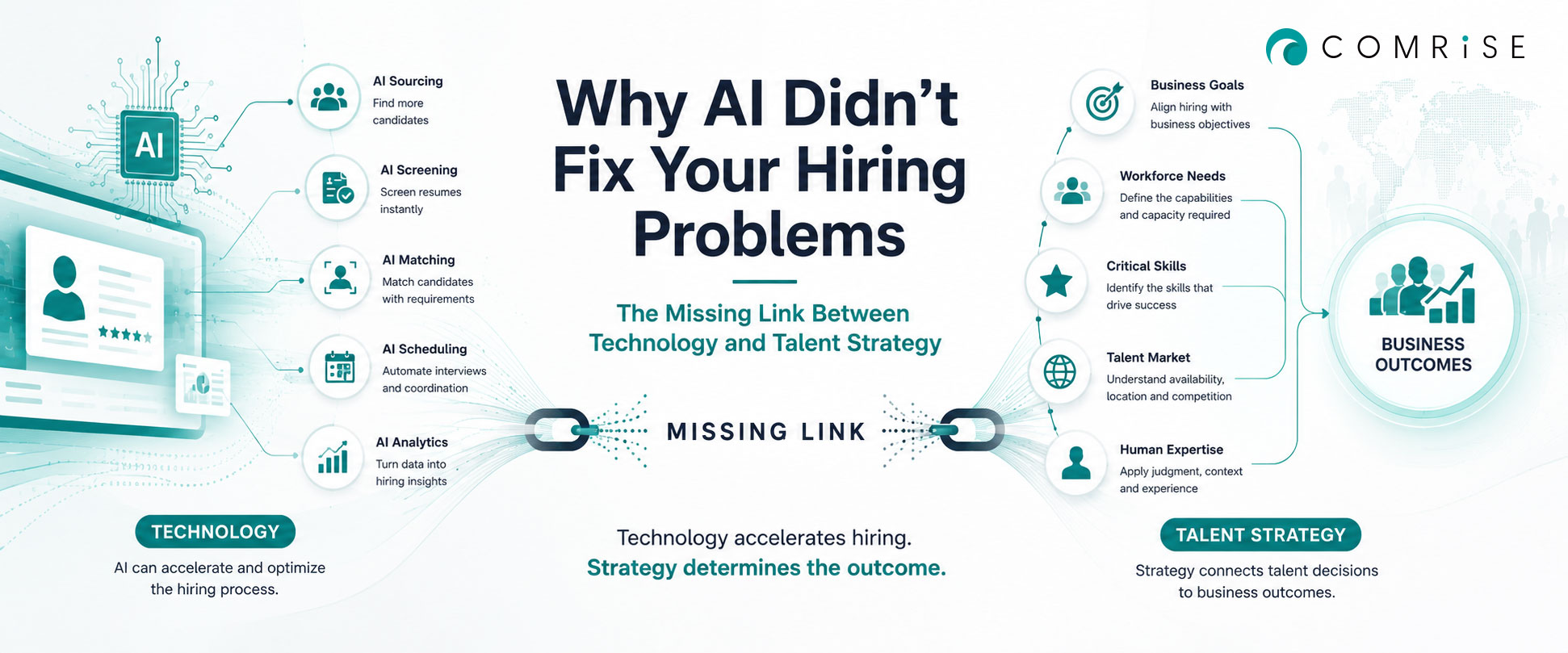
The infographic above illustrates the missing link: AI can optimize sourcing, screening, matching, scheduling and analytics—but talent strategy determines the direction of those activities.
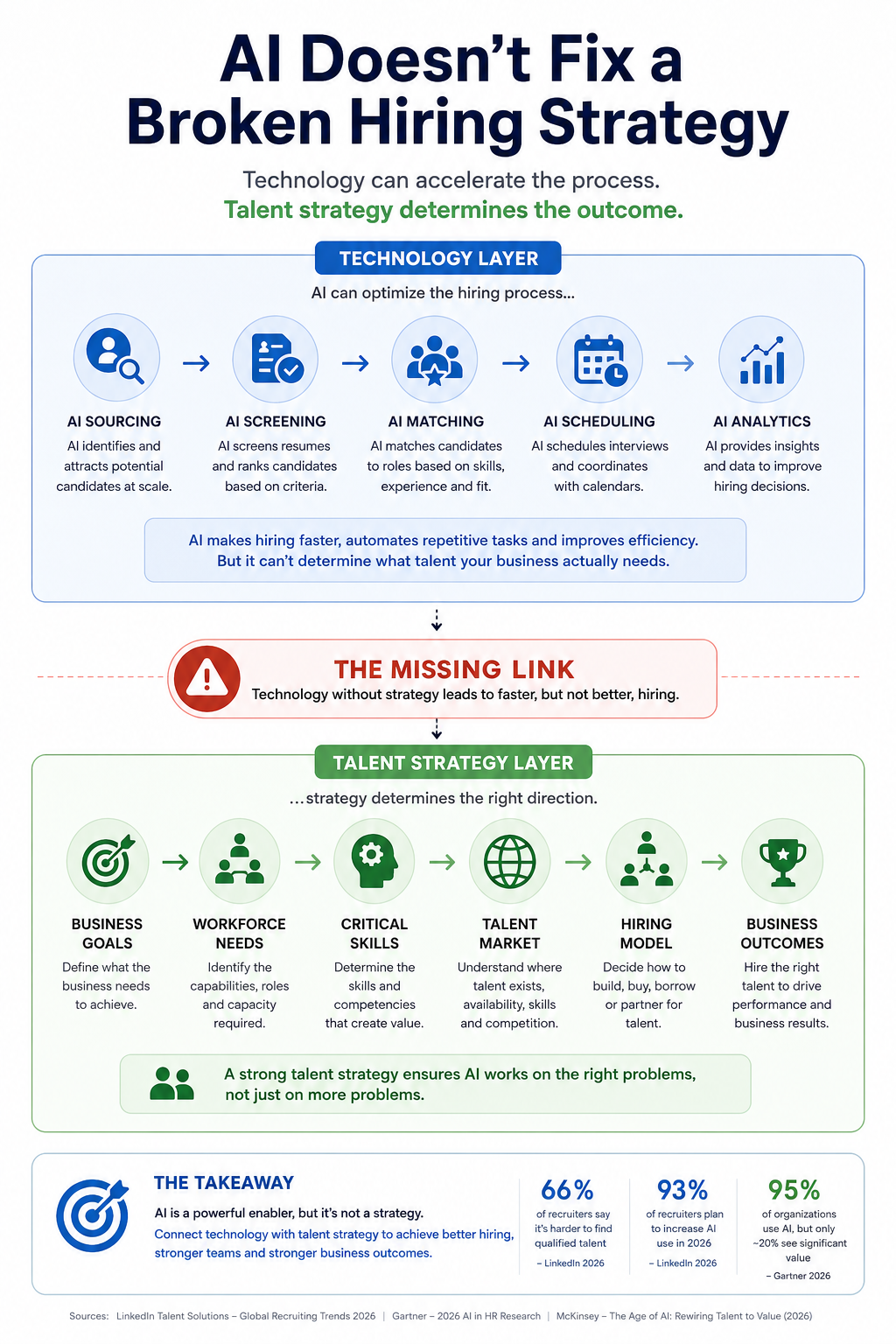
The Missing Link: Talent Strategy
A strong talent strategy connects business priorities with workforce decisions.
It starts with four questions.
1. What is the business trying to achieve?
Entering a new market, expanding manufacturing capacity, launching a product or building an AI capability can require very different workforce models.
Hiring should begin with the business objective, not simply the vacancy.
2. What capabilities are actually required?
Organizations need to look beyond job titles and identify the combination of:
Roles + Skills + Location + Capacity + Timing
This creates a clearer picture of the workforce required to execute the business strategy.
3. Where can those capabilities come from?
The answer may involve more than external hiring.
Companies can combine:
-
External recruitment
-
Internal mobility
-
Upskilling and reskilling
-
RPO
-
Cross-border recruitment
-
Contract talent
-
Strategic outsourcing
The right workforce model is often a combination of build, buy and borrow.
4. What should technology automate?
Only after the strategic questions are clear should organizations decide where AI can create the most value.
Strategy should determine technology—not the other way around.
AI Is a Capability, Not a Hiring Strategy
This distinction is becoming increasingly important.
AI can support activities such as:
-
Candidate sourcing
-
Resume screening
-
Candidate matching
-
Interview scheduling
-
Recruitment reporting
-
Talent data analysis
But human expertise remains critical for:
-
Workforce planning
-
Role definition
-
Talent strategy
-
Candidate engagement
-
Cultural assessment
-
Stakeholder alignment
-
Complex hiring decisions
The goal is therefore not AI versus humans.
It is:
Human Strategy + AI-Enabled Execution + Human Judgment
Gartner’s 2026 research shows why this distinction matters. While 95% of organizations have implemented AI in some capacity, only about one in five has realized significant or transformational value from those efforts.
AI adoption is increasing.
But adoption alone does not create business value.
The New Hiring Model: Human Strategy + AI Execution
The future of recruitment will not simply be about adding more AI tools.
It will be about redesigning how technology and people work together.
AI is well suited to high-volume, repetitive and data-intensive activities.
Human professionals are better positioned to interpret context, manage relationships, evaluate complex situations and connect workforce decisions to business priorities.
This becomes even more important as organizations move toward AI-enabled operating models.
McKinsey’s 2026 research argues that as AI agents increasingly work alongside people, companies need to rethink how they define valuable roles and organize talent around business outcomes.
The question is therefore shifting from:
“Who should we hire?”
to:
“What combination of people, skills, technology and AI capabilities will create the best business outcome?”
What Companies Should Rethink
Instead of asking:
“Which AI recruiting tool should we buy?”
Organizations should ask four more strategic questions.
1. Are we hiring for the right capabilities?
Start with business priorities and critical skills—not simply headcount.
2. Do we understand the talent market?
Talent availability, salary levels, geographic concentration, competition and candidate expectations all influence hiring outcomes.
Yet Gartner found in 2026 that only 31% of recruiting teams use labor-market data to inform talent strategy.
This represents a significant opportunity for recruiting teams to become a source of strategic market intelligence.
3. What should be automated?
Not every part of recruitment needs AI.
Automate where technology improves speed, scale and consistency.
Keep human involvement where judgment, trust and context matter most.
4. Are we measuring the right outcomes?
AI recruitment should not be evaluated only by:
-
Time saved
-
Applications processed
-
Recruiter productivity
Organizations should also track:
-
Quality of hire
-
Retention
-
Hiring-manager satisfaction
-
Candidate experience
-
Critical-skill coverage
-
Business impact
The ultimate measure of recruitment technology is not how much work it automates.
It is whether it helps the business build better capabilities.
From AI-Powered Recruiting to AI-Enabled Workforce Strategy
The next stage of AI in HR will move beyond:
“AI helps recruiters hire faster.”
It will increasingly become:
“AI helps organizations understand what workforce they need next.”
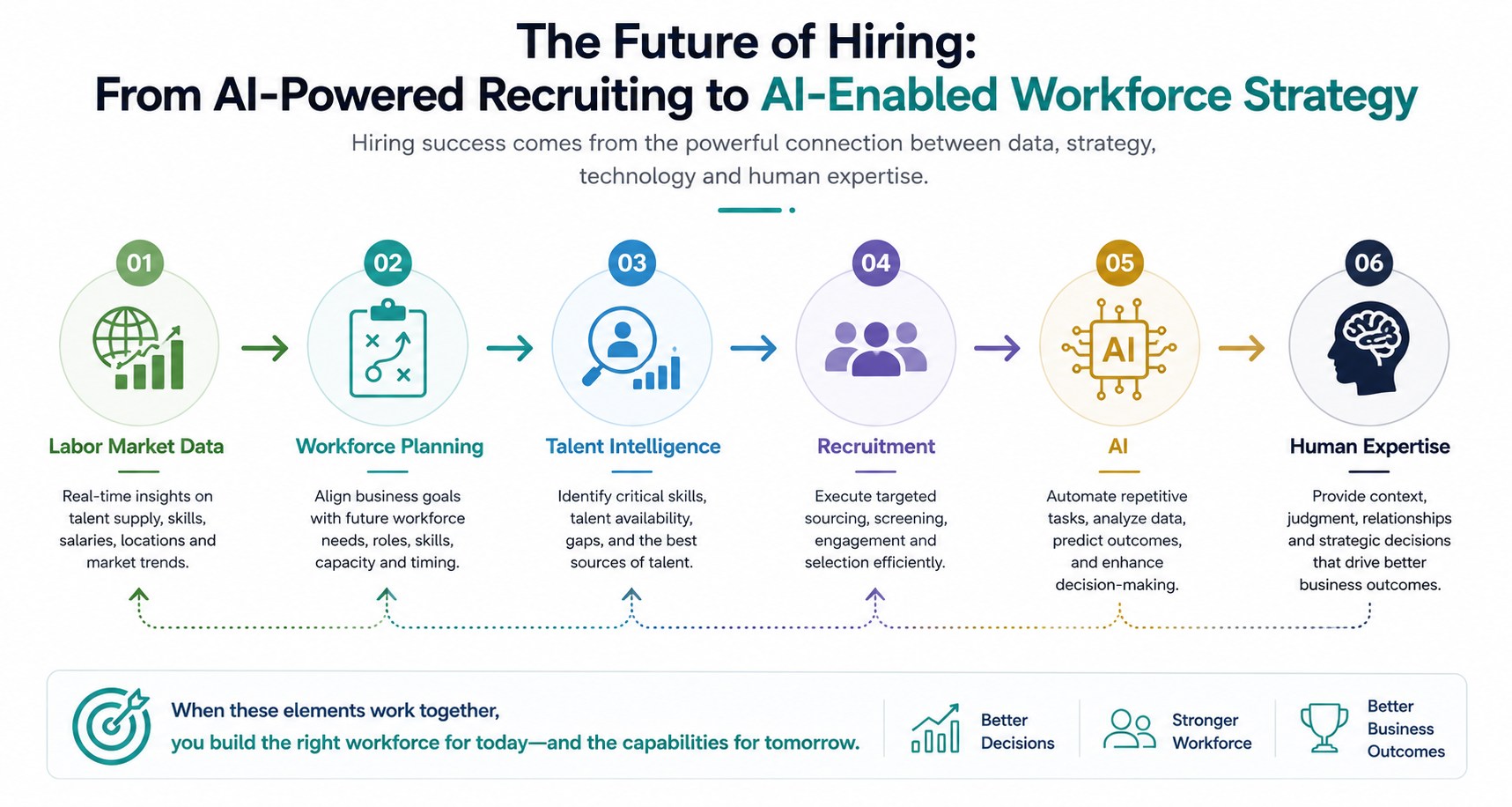
This is a broader shift from traditional talent acquisition toward AI-enabled workforce strategy.
As skills, technologies and business models continue to change, workforce planning can no longer be treated as a static annual exercise.
Organizations need a more dynamic understanding of where capabilities exist, which skills are becoming critical and how technology changes the way work is performed.
The Future of Hiring Isn’t AI vs. Humans
The companies that succeed in the next phase of talent acquisition will not necessarily be those with the most AI tools.
They will be those that know:
-
What capabilities the business needs
-
Where those capabilities can be found
-
Which capabilities should be developed internally
-
What technology should automate
-
Where human judgment must remain
-
How workforce decisions connect to business outcomes
AI can accelerate execution.
Talent strategy determines direction.
And human expertise ensures that technology is applied in the right context.
How Comrise Helps Connect Technology and Talent Strategy
For organizations navigating increasingly complex talent markets, technology is only one part of the solution.
Comrise combines talent intelligence, recruitment expertise, workforce strategy and technology-enabled delivery to help organizations build more effective hiring and workforce models.
Our capabilities support organizations across:
-
RPO & Talent Acquisition
-
Global Recruitment
-
Cross-Border Staffing
-
Workforce Strategy
-
Talent Market Intelligence
-
AI-Enabled Recruitment
-
Flexible Workforce Solutions
Whether a company is entering a new market, scaling a regional operation or building specialized capabilities, the objective is not simply to hire faster.
It is to build the right workforce for the business.