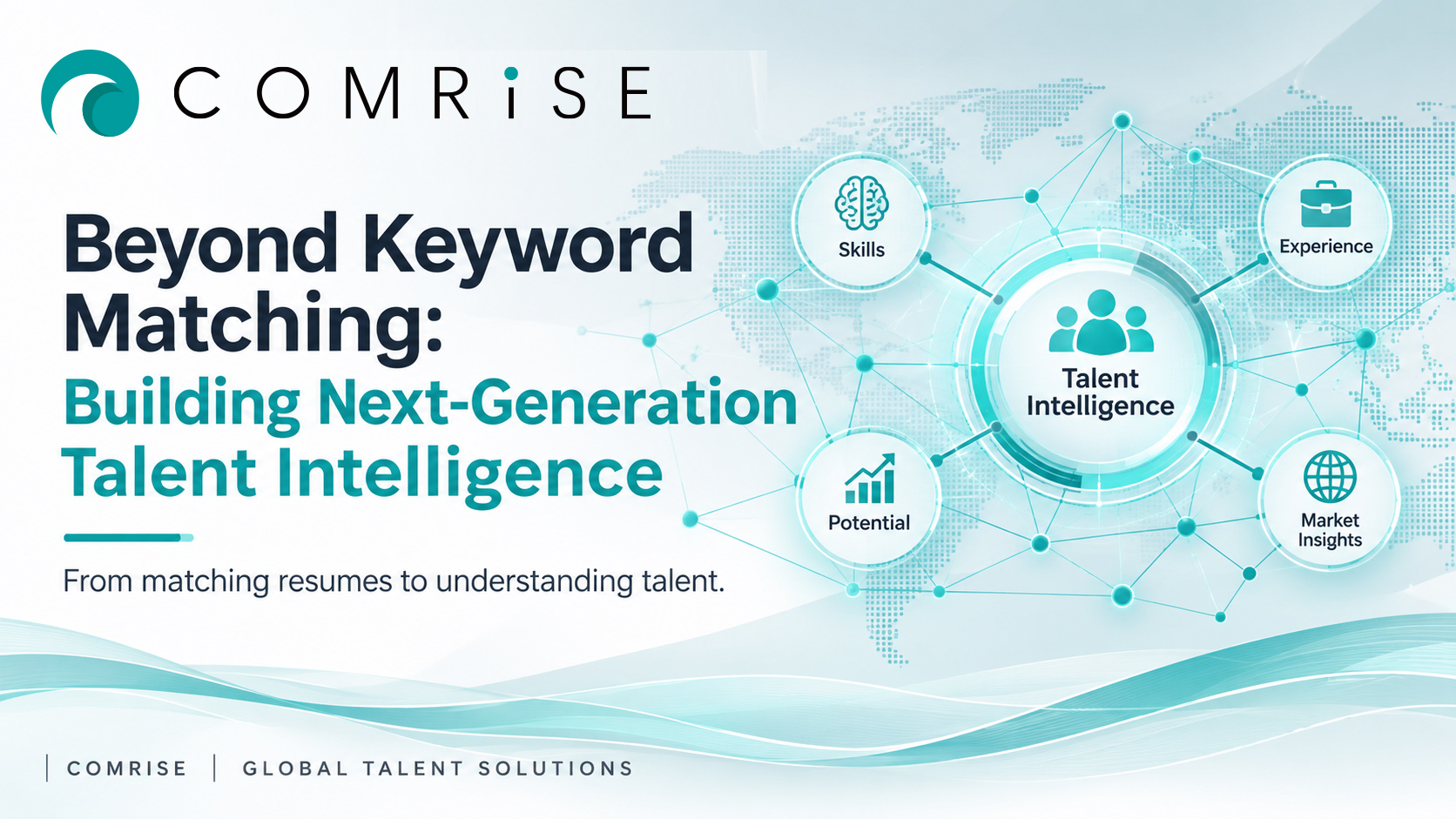
Beyond Keyword Matching: Building Next-Generation Talent Intelligence
Recruitment is entering a new phase. As AI reshapes how organizations identify and evaluate talent, the ability to understand skills, experience, and potential is becoming more important than simply matching keywords.
For years, recruitment technology has relied on a relatively straightforward approach: compare job descriptions with candidate resumes, identify matching keywords, and rank applicants based on how closely their profiles align with predefined requirements.
This approach helped recruiters manage growing volumes of applications and made candidate searches more efficient. However, as job requirements become more complex and talent markets increasingly interconnected, keyword matching alone is no longer enough.
A candidate may have the right capabilities without using the exact terminology in a job description. Someone working in an adjacent industry may possess highly transferable skills. Meanwhile, a professional’s career potential cannot always be understood through job titles or years of experience.
This is where AI-powered Talent Intelligence is changing the conversation.
Rather than simply identifying candidates who match a list of requirements, next-generation talent intelligence aims to understand what people can do, how their experience connects to business needs, and where relevant talent may be found.
1. Why AI Talent Intelligence Goes Beyond Traditional Keyword Matching
Traditional applicant tracking and recruitment systems have played an important role in organizing candidate information. By extracting keywords from resumes and comparing them with job descriptions, these systems help recruiters identify potential matches at scale.
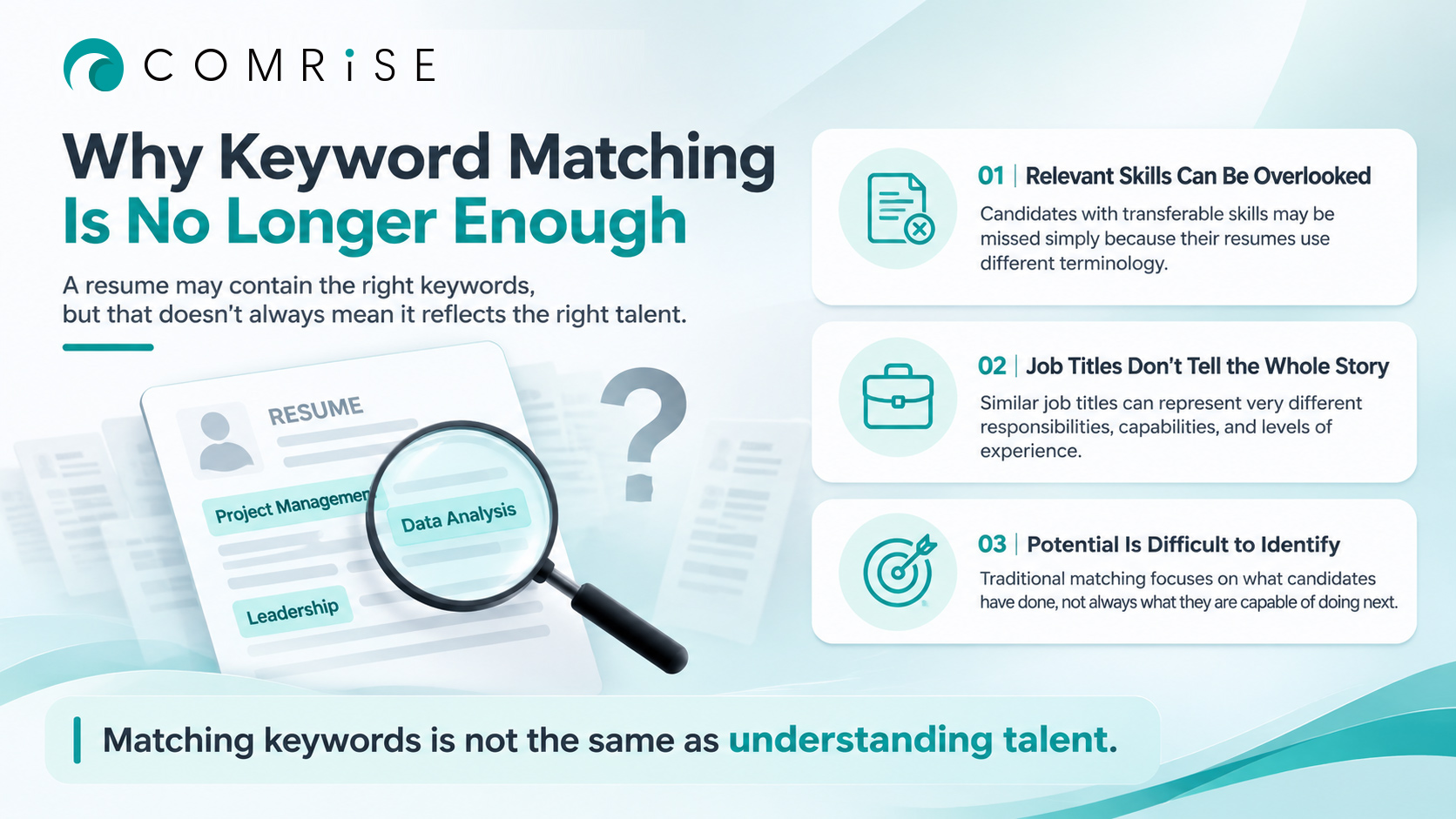
However, keyword-based recruitment has several limitations.
It can overlook relevant experience.
A candidate with strong project management experience may describe their work using terms such as operational delivery, cross-functional coordination, or program execution. If a job description specifically requires project management, a basic keyword search may fail to recognize the connection.
It places too much emphasis on job titles.
Job titles vary significantly across companies, industries, and countries. A Business Development Manager in one organization may perform responsibilities similar to a Commercial Director or Strategic Partnerships Lead elsewhere.
Matching job titles without understanding actual responsibilities can narrow the candidate pool unnecessarily.
It struggles to identify transferable skills.
As industries evolve, professionals increasingly move between related sectors. Experience in financial services, technology, manufacturing, or consumer businesses may provide relevant capabilities for roles outside a candidate’s previous industry.
A search based only on industry keywords may miss these opportunities.
It provides limited insight into talent potential.
A resume describes a professional’s experience, but it does not necessarily explain how that experience could translate into a new role or business environment.
For organizations hiring for emerging positions, evaluating potential and transferable capabilities is just as important as checking previous job titles.
The challenge is no longer simply finding resumes that contain the right words. It is understanding the professional capabilities behind those words.
2. From Keyword Matching to AI-Powered Skills Intelligence
AI is enabling recruitment systems to move beyond exact keyword comparisons toward more context-aware candidate identification.
Through Natural Language Processing (NLP), semantic analysis, and increasingly sophisticated AI models, recruitment technology can interpret relationships between job requirements and candidate experience.
This creates several opportunities.
Semantic Matching: Understanding Meaning, Not Just Words
Semantic matching evaluates the meaning and context of information rather than relying exclusively on identical terms.
For example, a company seeking a candidate with experience in process optimization may find relevant capabilities in a resume describing workflow improvement, operational efficiency, or business process transformation.
The terminology differs, but the underlying capabilities may be closely related.
This approach can help recruiters identify qualified professionals who might otherwise be overlooked by conventional search methods.
Skills Intelligence: Identifying What Candidates Can Actually Do
Instead of treating job titles as the primary indicator of suitability, AI can help extract and organize information about technical skills, functional capabilities, industry knowledge, and professional experience.
This enables recruiters to evaluate candidates through a more detailed skills-based perspective.
For example, when recruiting for a fintech business, relevant talent may come from traditional banking, payment technology, financial software, or digital commerce.
Understanding the relationship between these skill sets can expand the potential talent pool.
Transferable Skills: Discovering Talent Beyond Industry Boundaries
One of the most valuable opportunities in intelligent recruitment is identifying capabilities that can transfer across industries and functions.
A professional with experience in supply chain analytics may possess relevant data interpretation and process improvement capabilities for a manufacturing technology company.
Similarly, a financial services professional with strong regulatory and operational experience may be suitable for certain roles within a technology-driven business.
AI can help surface these potential connections, while recruitment professionals evaluate whether the candidate’s experience genuinely meets the requirements.
The result is a broader and potentially more effective approach to talent discovery.
3. Four Dimensions of Next-Generation Talent Intelligence
Talent Intelligence goes beyond improving candidate search. Its broader value lies in connecting candidate information with organizational needs and labor market insights.
Four dimensions are particularly important.
a. Skills and Capability Intelligence
Understanding the skills behind professional experience allows organizations to assess candidates more comprehensively.
This includes technical capabilities, functional expertise, industry knowledge, and transferable skills.
For employers, this creates opportunities to consider candidates from a wider range of professional backgrounds.
b. Contextual Experience Analysis
Experience should be evaluated in context.
The same job title can represent very different responsibilities depending on company size, industry, business maturity, geographic market, and organizational structure.
AI can help organize and interpret these different signals, giving recruiters a more structured starting point for candidate evaluation.
c. Potential and Career Alignment
A strong candidate is not always the person with the most similar previous job title.
Organizations may need professionals who can adapt to new technologies, enter emerging markets, or take on broader responsibilities.
By connecting skills, experience, and career progression, AI-supported analysis can help recruiters identify potential matches beyond conventional career paths.
However, potential still requires professional assessment, structured interviews, and validation against actual job requirements.
d. Market and Talent Supply Intelligence
Understanding available talent is essential to making effective hiring decisions.
Talent market intelligence helps organizations evaluate where relevant professionals are located, which industries they come from, how competitive the talent market is, and what challenges may affect recruitment.
When combined with structured candidate data and recruitment insights, this information can support better decisions about hiring locations, sourcing strategies, and workforce planning.
Together, these dimensions transform recruitment from a transactional search activity into a more informed talent decision-making process.
4. How AI Talent Intelligence Supports Strategic Recruitment Decisions
The value of Talent Intelligence becomes even more apparent when organizations face complex hiring and expansion challenges.
Consider three practical business scenarios.
Scenario 1: Building a Technology Team in an Emerging Market
A company entering Southeast Asia needs to recruit technology, commercial, and operational professionals.
A conventional approach may begin with searching for candidates who have already worked in the same industry and location.
A broader talent intelligence approach considers additional factors:
-
Which local industries have professionals with relevant transferable skills?
-
Where are the strongest talent pools located?
-
Which capabilities can be sourced locally, and which may require regional recruitment?
-
How do talent availability and hiring competition differ across markets?
These insights help employers develop a more realistic recruitment strategy before launching large-scale hiring activities.
Scenario 2: Recruiting for Emerging Technology Roles
Companies operating in AI, fintech, smart manufacturing, and other technology-driven sectors often face talent shortages in highly specialized positions.
The challenge is that traditional job titles and career paths may not fully reflect the capabilities required.
By mapping skills and related experience, recruiters can explore adjacent talent pools and identify professionals with relevant technical or functional backgrounds.
This does not mean every adjacent candidate is suitable. Rather, it provides a more comprehensive starting point for evaluating potential matches.
Scenario 3: Improving Recruitment Efficiency Across Multiple Positions
Organizations with ongoing or high-volume hiring requirements need more than isolated candidate searches.
They need a consistent understanding of job requirements, candidate availability, recruitment progress, and recurring talent gaps.
AI-supported recruitment workflows can help standardize information processing, improve candidate search, and reduce repetitive administrative work.
Recruiters can then devote more time to candidate engagement, assessment, and stakeholder communication.
In each scenario, Talent Intelligence helps connect recruitment execution with broader business decisions.
5. The Human Advantage: Why AI Still Needs Recruitment Expertise
As AI becomes more capable of processing candidate information, an important question emerges: What remains the role of professional recruiters?
The answer is not to compete with AI in processing information. It is to use technology to strengthen professional judgment.
AI can help recruiters:
-
Parse resumes and structure candidate information.
-
Identify relevant skills and experience.
-
Discover potential matches across different industries.
-
Prioritize candidate searches.
-
Organize recruitment data and identify patterns.
However, recruitment decisions involve factors that cannot be fully understood through resume data alone.
Motivation, communication, leadership style, cultural alignment, career expectations, and the context behind professional achievements all require deeper evaluation.
A candidate may appear highly relevant based on technical qualifications but have different career expectations from the hiring organization.
Another candidate may have a less conventional background but demonstrate strong potential through relevant achievements and transferable capabilities.
These distinctions require human understanding.
The strongest recruitment model is therefore not AI replacing recruiters, but AI and recruitment professionals working together.
AI improves the speed and structure of information processing. Experienced consultants bring industry knowledge, relationship-building capabilities, and contextual judgment.
Together, they can support more informed and effective hiring decisions.
6. How Comrise Connects AI Recruitment with Global Talent Intelligence
At Comrise, we believe the future of recruitment lies in combining technology, professional expertise, and market understanding.
As a global HR services provider with experience across North America and Asia, we support organizations navigating complex talent requirements across industries and geographic markets.
Our approach connects AI-supported recruitment processes with professional talent acquisition and global delivery capabilities.
AI-Powered Recruitment
AI-enabled recruitment workflows can support resume parsing, job description analysis, candidate information processing, and talent matching.
By reducing repetitive tasks and improving information consistency, these capabilities help recruitment consultants focus more effectively on candidate assessment and client engagement.
Professional Talent Mapping
Understanding where talent comes from is as important as identifying who matches a particular role.
Comrise combines industry knowledge and recruitment experience to support talent mapping, identify relevant candidate pools, and explore talent opportunities across related industries and functions.
Industry and Market Expertise
Different industries require different talent strategies.
Our recruitment experience spans areas including technology, financial services, consumer and retail, manufacturing, and cross-border business operations.
This industry understanding helps connect recruitment requirements with the realities of specific talent markets.
Global Talent Solutions
For organizations expanding internationally, talent intelligence must extend beyond individual candidate profiles.
Employers need to understand local talent availability, recruitment conditions, and workforce requirements across different markets.
Through our global recruitment and cross-border HR capabilities, Comrise supports businesses in developing talent strategies and building teams across North America and Asia.
Our objective is to help organizations move beyond searching for candidates who simply match a job description, toward making better-informed talent decisions.
The Future of Recruitment Is About Understanding Talent
Keyword matching helped recruitment become more structured and scalable. AI is now creating opportunities to make talent identification more contextual, skills-oriented, and data-informed.
But technology alone does not create better hiring outcomes.
The real value comes from combining accurate information, intelligent analysis, professional recruitment expertise, and a clear understanding of business needs.
For organizations competing for talent in increasingly complex markets, the next generation of recruitment will not be defined by how many resumes can be processed.
It will be defined by how effectively businesses understand talent and connect the right capabilities with the right opportunities.
AI can identify patterns. People recognize potential. Together, they enable smarter talent decisions.
Build a Smarter Talent Strategy with Comrise
Whether you are expanding into new markets, building specialized teams, or improving your recruitment processes, Comrise can help connect talent intelligence with practical recruitment solutions.
Contact our team to explore how AI-powered recruitment and global talent expertise can support your business.
Email: marketing@comrise.com
Website: https://www.comrise.com/