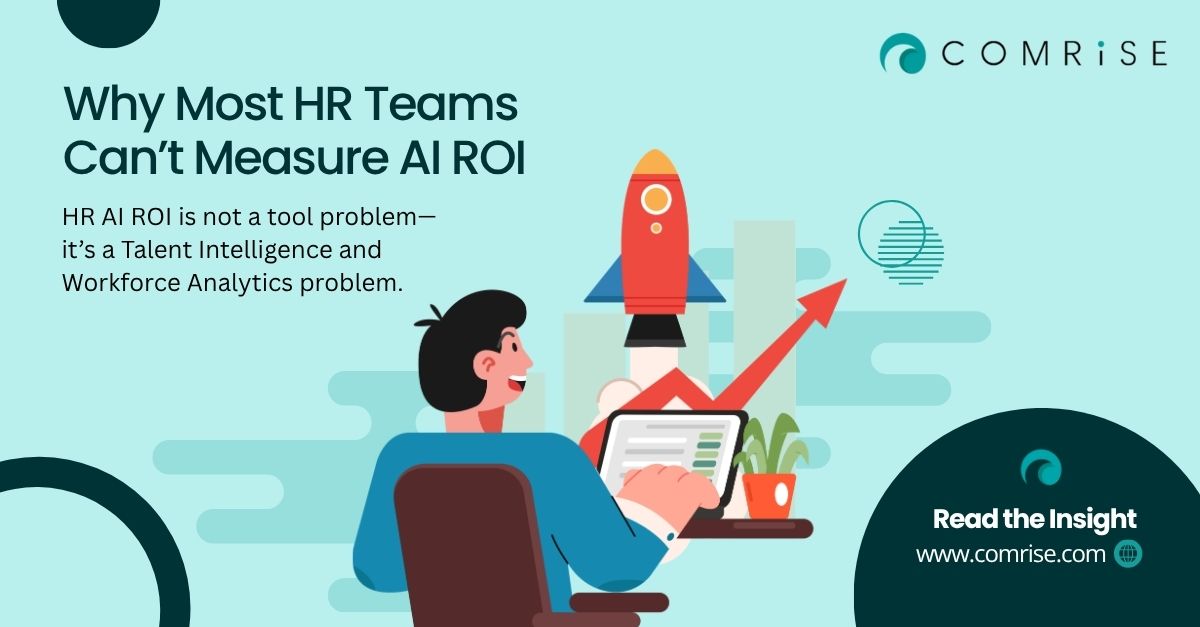
The HR AI ROI Problem No One Can Ignore
AI adoption in HR is accelerating rapidly—from recruitment automation to workforce planning and employee experience optimization.
However, one critical gap persists across most organizations:
Most HR teams cannot accurately measure HR AI ROI.
The issue is not AI capability.
It is the lack of mature Talent Intelligence systems and fragmented Workforce Analytics frameworks.
Without a unified measurement model, AI in HR becomes visible in activity—but invisible in business impact.
1. Why HR AI ROI Is So Difficult to Measure
Traditional HR measurement systems were never designed for AI-driven workflows.
Most organizations still rely on:
- Time-to-hire
- Cost-per-hire
- Recruiter productivity
- Vacancy fill rate
These metrics measure efficiency—but not intelligence or impact.
The result is a structural blind spot:
HR teams can measure activity, but not true HR AI ROI.
Because AI doesn’t just speed up hiring—it reshapes decision-making across the entire talent lifecycle.
2. The Shift from HR Metrics to Talent Intelligence
Modern organizations are moving toward Talent Intelligence—a data-driven approach that connects hiring, performance, and workforce planning.
Unlike traditional HR reporting, Talent Intelligence enables organizations to:
- Predict hiring success before hiring decisions are made
- Identify high-quality talent signals at scale
- Align recruitment with long-term business outcomes
In this model, HR AI ROI is no longer measured by task automation.
Instead, it is measured by:
- Quality of hire
- Employee retention rates
- Time-to-productivity
- Workforce performance outcomes
3. Why Workforce Analytics Is the Missing Link
Even organizations investing heavily in AI often fail to connect systems.
Typical HR tech stacks include:
- Applicant Tracking Systems (ATS)
- Human Resource Information Systems (HRIS)
- AI sourcing and screening tools
- External assessment platforms
But these systems rarely communicate effectively.
This creates a major barrier for Workforce Analytics:
- Data is siloed
- Attribution is unclear
- ROI cannot be traced end-to-end
Without integrated Workforce Analytics, AI impact remains fragmented and difficult to quantify.
4. Why Traditional ROI Models Fail in AI-Driven HR
Most HR ROI frameworks assume linear processes:
Input → Process → Output
But AI introduces non-linear dynamics:
- Automated sourcing changes candidate pools
- AI screening impacts hiring quality upstream
- Predictive analytics alters decision timing
This breaks legacy measurement logic.
As a result:
- Faster hiring does not always equal better hiring
- Lower cost may not improve long-term retention
- Efficiency gains may hide quality degradation
This is why HR AI ROI cannot be measured using legacy HR KPIs alone.
5. The New Model: System-Level HR AI ROI
Leading organizations are shifting toward a system-level approach to measurement.
Instead of evaluating individual tools, they evaluate the entire talent system:
a. System ROI over Tool ROI
Measure AI impact across the full hiring lifecycle, not isolated processes.
b. Outcome-Based Metrics over Activity Metrics
Focus on:
- Talent quality
- Retention performance
- Business productivity
c. Integrated Workforce Analytics
Unify ATS, HRIS, and AI systems into a single data layer for attribution.
This is where real Talent Intelligence emerges.
6. The Comrise Perspective on HR AI ROI
At Comrise, we see a consistent pattern across global hiring programs:
Organizations are investing in AI faster than they are upgrading their measurement systems.
This creates a critical gap:
- AI improves operational efficiency
- But HR AI ROI remains undefined
- Leadership cannot fully validate AI investment impact
Without Workforce Analytics maturity, AI adoption risks becoming fragmented automation rather than strategic transformation.
7. What HR Leaders Need to Do in 2026
To unlock real value from AI in HR, organizations must evolve in three areas:
a. Upgrade from HR Metrics to Talent Intelligence
Move beyond activity tracking toward predictive, outcome-based insights.
b. Build Integrated Workforce Analytics Infrastructure
Connect HRIS, ATS, and AI tools into a unified data ecosystem.
c. Redefine HR AI ROI Frameworks
Measure AI based on:
- Hiring quality
- Retention outcomes
- Workforce productivity impact
Conclusion: The Future of HR AI ROI Is Measurement, Not Just Adoption
AI is not failing HR.
Measurement systems are.
The organizations that succeed in the next phase of HR transformation will not simply adopt AI faster.
They will:
Measure Talent Intelligence more accurately and build true Workforce Analytics capabilities.
Because in the future of HR:
- AI adoption is common
- But measurable HR AI ROI is rare
- And that gap defines competitive advantage