Synopsis
When Silicon Valley giants begin freezing hiring and Wall Street investment banks scale back campus recruitment, the U.S. job market in 2025 is sending strong signals—the decade-long “war for talent” is quietly shifting course!
According to the latest data from the U.S. Bureau of Labor Statistics (BLS), non-farm payroll growth has fallen to its lowest level in nearly five years, while the wave of AI substitution is reshaping job demand…
Whether you are a company hiring for a North American team or an HR professional planning a global talent strategy, U.S. employment trends in 2025 will directly impact your hiring approach.
This article provides a comprehensive breakdown of the latest trends from three perspectives—”Data + Industry Insights + The Chinese Enterprise Viewpoint”—and reveals:
-
Which job opportunities are increasing?
-
Which industries are cooling down?
-
What are the implications for Chinese enterprises?
-
How should recruitment strategies be adjusted?
01|The U.S. Job Market Enters a “Moderate Cooling Period”
According to the latest data from the U.S. Bureau of Labor Statistics (BLS), three clear signals are emerging in the U.S. job market:
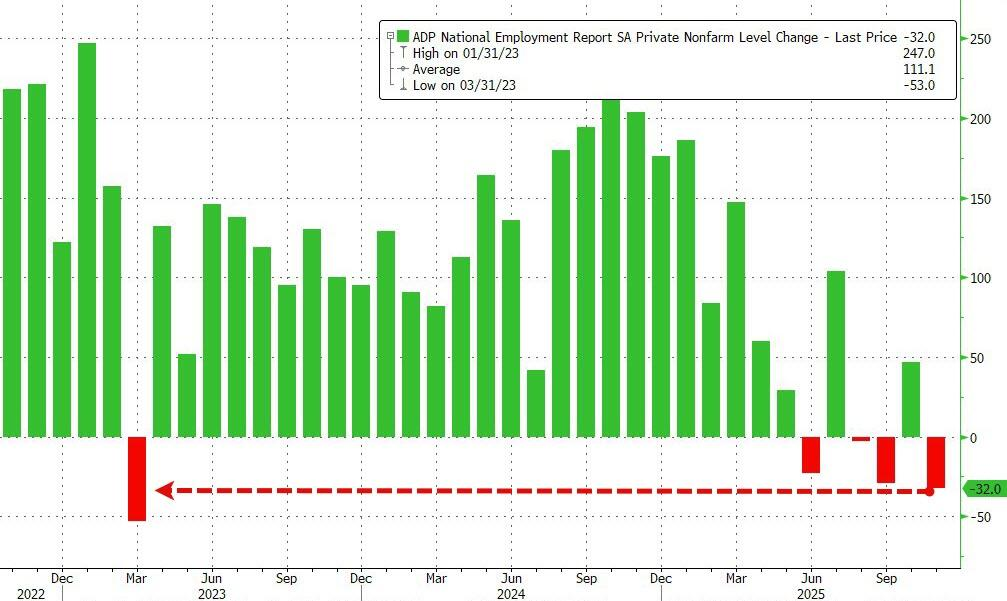
Signal ① Slowing Non-Farm Payroll Growth The latest data from the BLS shows only 119,000 jobs were added in September, with growth continuing to decelerate. Furthermore, data released by Automatic Data Processing, Inc. (ADP) on December 3rd shows the private sector lost 32,000 jobs in November, the largest decline since March 2023 and far worse than the market expectation of a 40,000-job increase. This data highlights the growing pressure on the U.S. labor market.
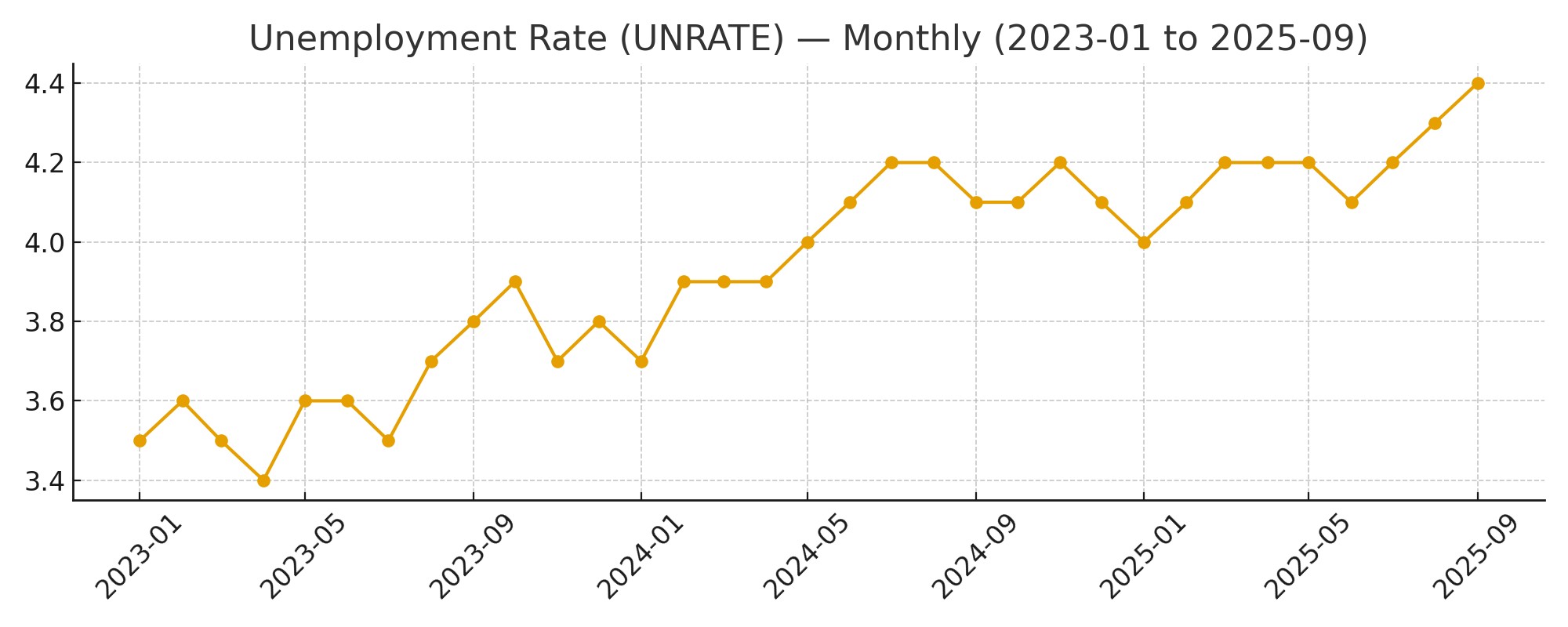
Source: U.S. Bureau of Labor Statistics (BLS), retrieved via FRED.
Signal ② Slight Uptick in Unemployment Rate The U.S. unemployment rate has risen to 4.4%, a recent minor peak. Note: This is not a crisis, but a trend of normalization from “overheating.”
Signal ③ Market Shifts from Rapid Expansion to Rational Adjustment Companies are hiring more cautiously, recruitment cycles are lengthening, and requirements for candidates are higher.
In summary: The U.S. job market has not collapsed, but it is indeed “harder to find a job and harder to hire the right person compared to last year.”
02|Three Major Trends Reshaping the U.S. Recruitment Landscape
Trend 1: Slower Hiring → Fiercer Competition for New Entrants U.S. companies have widely entered a hiring mode focused on “controlling costs, headcount (HC), and risk.” Hiring hasn’t stopped but has become more selective. This is reflected in:
-
Fewer new job openings
-
The number of job seekers is increasing, not decreasing
-
Companies are “reviewing more candidates per opening”
-
Intensified competition for campus recruitment and entry-level positions
A Silicon Valley recruiting lead told us: “We now receive 400+ resumes for an entry-level position, double the volume from the past two years.” This highlights a significant trend—job hunting has become more competitive, but companies are finding it easier to identify “better-fit” talent.
Trend 2: Widening Industry Divergence, Clear Structural Opportunities Industry growth in the U.S. shows a pronounced polarization:
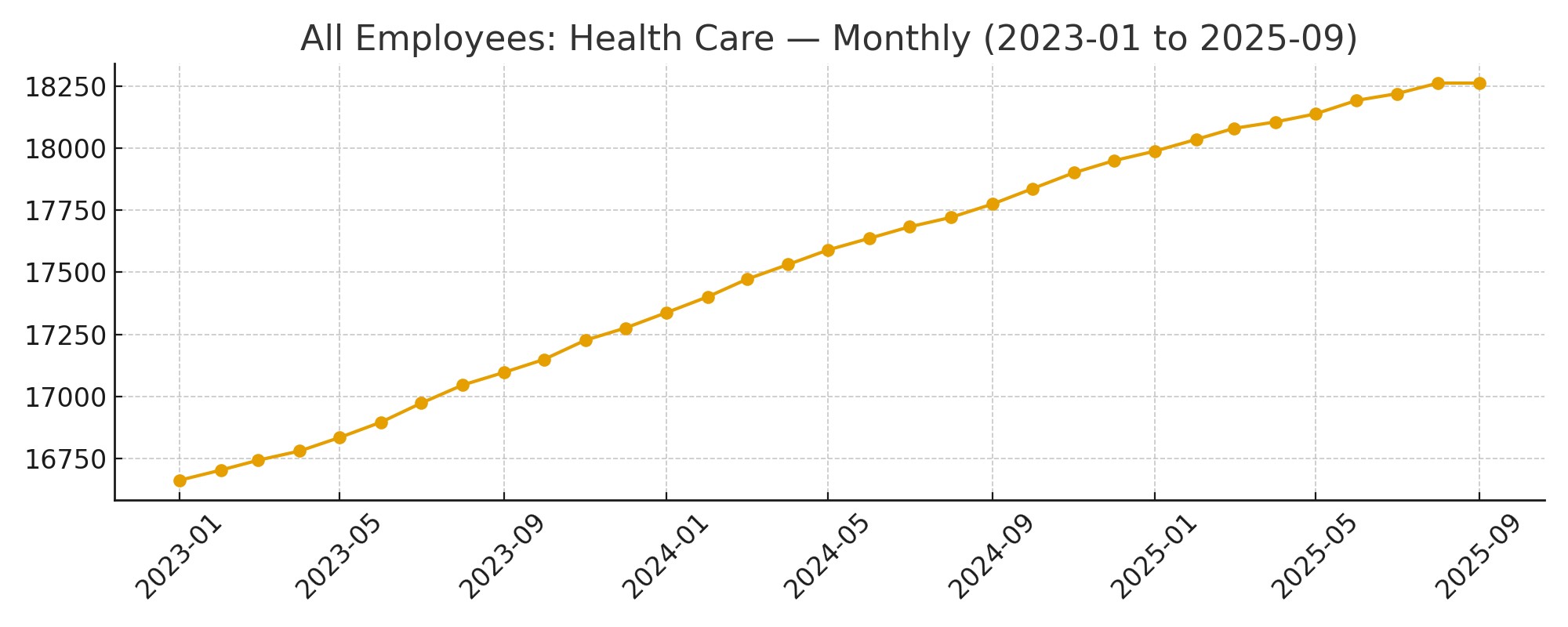
Source: U.S. Bureau of Labor Statistics, retrieved via FRED.
Industries with Strong Growth: Healthcare
-
Steadily adding jobs monthly
-
Chronic talent shortage
-
One of the most “counter-cyclical” industries An aging population and an expanding healthcare system make this sector the most stable engine for U.S. job growth.
Industries with Notable Decline: Transportation & Warehousing
-
Ongoing job contraction
-
Impact of automation is evident
-
An industry experiencing “accelerated displacement” → This indicates: Talent is migrating from traditional industries towards high-value-added/high-tech fields.
Trend 3: AI Accelerates Talent Restructuring, High-Skill Roles Are More Sought-After The adoption of AI, automation, and digital technologies by U.S. companies is accelerating:
-
For low-skill roles: Substitution effect is evident.
-
For high-skill/compound-skills roles: Demand continues to rise.
U.S. companies are increasingly emphasizing the following capabilities in their hiring:
-
Digital skills
-
Cross-functional integration ability
-
Stronger self-directed learning ability
The structure of job demand in the U.S. market will continue to evolve towards higher skill levels.
03|Implications for Chinese Enterprises and Multinational HR: Risk and Opportunity
For Chinese companies expanding overseas, multinational teams, and cross-border recruitment departments, changes in U.S. employment trends deliver several key signals:
-
High-skill roles are more worth investing in: Talent in technology, healthcare, engineering, and senior management remains in short supply, offering a higher return on recruitment investment.
-
Extended recruitment cycles, potentially higher costs: Companies need to plan recruitment timelines in advance to avoid gaps in critical positions.
-
Increased demand for outsourcing, headhunting, and flexible staffing services: Companies need more agile ways to cope with uncertainty and fluctuations in talent costs.
-
Chinese enterprises can leverage a “global talent strategy” to reduce labor costs: More Chinese companies are improving efficiency and mitigating risk through globalized talent strategies.
In summary, the U.S. job market is transitioning from high-speed growth to a “moderate cooling.” Industry divergence and technological transformation are the core drivers. For enterprises:
-
Now is an excellent time to re-evaluate recruitment strategies.
-
It is also a critical juncture for deploying global talent and enhancing organizational competitiveness.
Comrise
At Comrise, we offer tailored solutions for the full-time, part-time, direct-hire, contract, and permanent talent that your business needs. For 40 years, we have delighted our clients and candidates by focusing on customer satisfaction, innovation, and flexible workforce solutions!
If you’re looking for new job opportunities click here, or if you’re looking for a reliable partner to help you secure top-notch candidates for hard-to-fill roles, click here. For more information, feel free to contact us, click here.